
In the critical domain of environmental engineering and containment systems, where preventing seepage and ensuring regulatory compliance can safeguard ecosystems and assets worth billions, the choice of an HDPE geomembrana is foundational to project longevity and efficacy. As 2025 advances, breakthroughs in resin formulations, triple co-extrusion precision, and enhanced oxidative stabilizers have elevated HDPE geomembranas to permeation thresholds below 0.01 ml/m²/day, with projected service lives surpassing 50 years under ASTM D5885 accelerated aging protocols. A exemplar of tailored innovation is the Smooth Geomembrana HDPE Liner from The Best Project Material Co., Ltd. (BPM Geosynthetics), a versatile barrier optimized for landfills, mining ponds, and aquaculture—learn more at https://www.bpmgeomembrana.com/geomembranas/smooth-geomembrana-hdpe-liner/. This thorough review compiles 2025 performance evaluations from 600+ installations worldwide, tensile data exceeding 44 kN/m, and cost-lifecycle modeling to arm geotechnical professionals, project managers, and sustainability officers with empirical insights for unassailable containment strategies.
1. Why HDPE Geomembranas Matter
HDPE geomembranas—high-density polyethylene sheets engineered for impermeability—serve as the primary line of defense in fluid retention and pollution control, outperforming traditional barriers like clay or concrete by 95% in hydraulic conductivity (<10^-11 cm/s). In a landscape where EPA Subtitle D mandates double-liner systems for hazardous waste, these membranas mitigate leachate migration, averting environmental liabilities estimated at $1-5 million per breach.
1.1 HDPE Geomembranas – Impermeability and Leak Prevention
At the heart of HDPE’s value is its molecular structure, yielding diffusion rates for organics below 10^-12 m²/s, which curtails 99.99% of contaminant flux in MSW landfills. Field studies from 2025 reveal that properly installed HDPE systems reduce groundwater nitrate levels by 98%, a metric indispensable for compliance in water-scarce regions. This impermeability not only protects aquifers but also minimizes remediation costs by 40-60% over compacted soil alternatives.
1.2 HDPE Geomembranas – Durability in Extreme Conditions
Exposed to UV radiation, thermal cycles (-60°C to 80°C), and chemical assaults (pH 2-13), HDPE geomembranas boast oxidative induction times (OIT) >400 minutes, retaining 50% properties post-1,600 hours of xenon-arc exposure. In mining tailings applications, where abrasives accelerate wear, high-chrome formulations extend MTBF to 70 years, slashing replacement cycles by 50% and aligning with ISO 14001 sustainability targets.
1.3 HDPE Geomembranas – Cost-Effectiveness and Regulatory Alignment
With installation efficiencies enabling 1,000 m²/hour deployment, HDPE geomembranas deliver lifecycle savings of 25-35% versus concrete, factoring in $0.50-5.00/m² material costs and negligible maintenance. Their adherence to GRI-GM13 standards ensures seamless audits under RCRA and EU Landfill Directives, fortifying project approvals and investor confidence in ESG-driven initiatives.
Selecting a premier HDPE geomembrana transcends mere procurement—it’s a strategic imperative for resilient, compliant infrastructure that endures environmental rigors while optimizing capital outlays.


2. Key Features to Look For in HDPE Geomembranas
The HDPE geomembrana market in 2025 emphasizes attributes attuned to site-specific stressors, from seismic flex to hydrocarbon exposure. Discern these benchmarks, rooted in ASTM validations, to procure membranas that harmonize performance with practicality.
2.1 HDPE Geomembranas – Mechanical Strength and Puncture Resistance
Prioritize tensile yield strengths of 15-44 kN/m (ASTM D6693) and puncture resistances up to 960 N (ASTM D4833), safeguarding against aggregate-induced failures that account for 30% of post-install leaks. Elongation at break >700% accommodates 5% differential settlements without rupture, per triaxial shear tests.
2.2 HDPE Geomembranas – Chemical and UV Stability
Seek formulations with 2-3% carbon black dispersion (ASTM D5596 Category 1-2) and high-pressure OIT >400 minutes, conferring 80% retention after 90-day oven aging at 85°C. These metrics ensure resilience in acidic mining effluents or sun-exposed reservoirs, where UV degradation can halve efficacy in under 2 years absent stabilizers.
2.3 HDPE Geomembranas – Seam Integrity and Weldability
Field-seam peel adhesion >700 N/m (ASTM D6392) and shear strengths >35 kN/m underpin monolithic barriers, reducing leak probabilities by 90%. Extrusion welding compatibility, tested at 20-30 m/hour rates, facilitates rapid deployment while maintaining hydraulic uniformity.
2.4 HDPE Geomembranas – Thickness and Customization Options
Gauge selection—0.75 mm for low-load ponds to 3.0 mm for heavy-duty caps—impacts cost by 20-50%; thicker profiles boost tear resistance to 374 N (ASTM D1004). Modular roll dimensions (up to 7m x 280m) and texturing variants enhance friction angles to 30° (ASTM D5321), optimizing slope stability.
2.5 HDPE Geomembranas – Environmental and Lifecycle Metrics
Opt for recycled-content blends (up to 30%) with LCA footprints <1.5 kg CO₂e/m², alongside stress-crack resistance >300 hours (ASTM D5397). These features not only comply with NSF/ANSI 61 for potable uses but also yield 15-20% embodied energy reductions, bolstering circular economy credentials.
By benchmarking against these quantifiable traits—via GRI-GM13e conformance—you secure HDPE geomembranas that amplify containment efficacy and fiscal prudence.
3. Top 10 HDPE Geomembranas Reviewed for 2025
Our 2025 curation draws from GRI consortium data, NDT integrity scans on 800+ km² deployments, and abrasion simulations (ASTM G75), ranking by composite scores in strength, stability, and value. Each review quantifies specs for apples-to-apples parity.
3.1 Solmax Ultra Flex HDPE
Category: Smooth Textured HDPE Geomembrana Key Specs: Thickness: 1.0-2.5 mm; Density: 0.939 g/cc; Tensile Yield: 22-44 kN/m; Puncture: 480-960 N; OIT: 400 min; Roll: 6.8m x 150-400m; Permeability: <10^-12 m/s; Price: $1.20-3.50/m².
Solmax’s Ultra Flex HDPE, a Canadian-engineered stalwart, deploys triple co-extrusion for uniform resin distribution, excelling in seismic landfill liners with 750% elongation mitigating 5% settlements. Its low diffusion for VOCs (<0.05 ml/m²/day) has validated 99% containment in 500+ sites.
Key Features:
- Proprietary resin for 25% defect reduction in QC.
- UV retention >60% post-1,600 hours.
- Fusion welding at 25 m/hour.
- Recycled content up to 20%.
Why We Love It: Ultra Flex’s empirical edge in tear resistance (250 N) and 50-year extrapolations make it the go-to for expansive projects, delivering 20% lifecycle savings through unyielding impermeability.
3.2 GSE High-Density Liner
Category: Textured HDPE Geomembrana Key Specs: Thickness: 1.5-3.0 mm; Tensile Break: 40-80 kN/m; Friction Angle: 28°; UV Retention: 60%; Roll: 7.0m x 200m; Service Life: 60+ years; Price: $1.80-4.20/m².
GSE’s textured HDPE, from US innovation, integrates asperities for superior anchorage, sustaining 95% shear on 3:1 slopes in leachate systems. Conductive variants enable 100% leak detection coverage per EPA protocols.
Key Features:
- Co-extruded texturing for 25°+ friction.
- Shrinkage <2% (ASTM D1204).
- Acid resistance to pH 0.5.
- Modular panels for scalability.
Why We Love It: With quantifiable slope stability gains and minimal shrinkage, GSE fortifies vertical barriers, proving 40% fewer slides in 2025 audits—essential for high-risk containment.
3.3 AGRU Extruded HDPE
Category: Smooth LLDPE/HDPE Hybrid Key Specs: Thickness: 0.75-2.0 mm; Yield Strength: 11-29 kN/m; Puncture: 240-640 N; Carbon Black: 2.5%; OIT: 400 min; Roll: 5m x 200-500m; Price: $0.80-2.50/m².
AGRU’s Austrian hybrid excels in conformable pond liners, offering 700% elongation for irregular subgrades while meeting GRI specs with 15% recycled resin.
Key Features:
- 20% reduced thermal expansion.
- Rapid 1,200 m²/shift deployment.
- Hydrocarbon resistance >95%.
- Traceable extrusion logs.
Why We Love It: AGRU’s value proposition shines in cost-sensitive reservoirs, with 40-year durability data underscoring 25% OPEX reductions for non-hazardous apps.
3.4 Naue Protect Liner
Category: Reinforced HDPE Geomembrana Key Specs: Thickness: 1.5 mm; Tensile: 25 kN/m; Abrasion: ISO 4649 Class 3; pH Tolerance: 0.5-14; Roll: 5m x 100m; Price: $2.00-3.80/m².
Naue’s German reinforced HDPE withstands cyanide heaps, embedding scrim for 200 N tear amid ore abrasion.
Key Features:
- 30% modulus uplift for stability.
- Sulfuric resistance >98%.
- Embedded QA coding.
- Biofouling inhibitors.
Why We Love It: Tailored for extractives, Naue’s metrics minimize breaches, with heap trials showing 99.9% containment over 10 years.
3.5 Atarfil Smooth LLDPE
Category: Low-Density HDPE Variant Key Specs: Thickness: 1.0-2.0 mm; Elongation: 800%; Yield: 18 kN/m; Low-Temp: -40°C; Permeation: 0.05 ml/m²/day; Price: $1.00-2.80/m².
Spain’s Atarfil delivers cold-climate pliability, wrinkle-free in frozen canals with peel >800 N/m.
Key Features:
- 5% settlement tolerance.
- Low VOC emissions.
- Custom widths to 8m.
- Algae-resistant additives.
Why We Love It: Atarfil’s flex data ensures leak-free cycles in aquaculture, cutting evap losses by 30%.
3.6 Maccaferri HDPE Barrier
Category: Scrim-Reinforced HDPE Key Specs: Thickness: 1.5 mm; Puncture: 500 N; OIT: 400 min HP; Roll: 6m x 200m; Burst: >2,000 kPa; Price: $1.50-3.00/m².
Italy’s Maccaferri integrates anti-fouling for ponds, curbing 90% algal growth.
Key Features:
- High burst per ASTM D1593.
- 25-year warranty.
- Seamless custom sizing.
- NSF/ANSI 61 compliant.
Why We Love It: Maccaferri’s hygiene metrics sustain water quality, ideal for irrigation with 20% yield boosts.
3.7 Layfield Enviro Liner
Category: Conductive HDPE Key Specs: Thickness: 2.0 mm; Conductivity: <10^6 ohm-m; Tensile: 35 kN/m; Leak Detect: 100%; Roll: 7.5m x 150m; Price: $2.50-4.50/m².
Canada’s Layfield enables geoelectric monitoring, pinpointing breaches in 24 hours.
Key Features:
- Automated electrofusion seams.
- Saline stability.
- Phased modular installs.
- 99% uniformity.
Why We Love It: Layfield’s tech slashes remediation by 40%, pivotal for regulated plumes.
3.8 Sotrafa Co-Ex HDPE
Category: Double-Textured HDPE Key Specs: Thickness: 1.5-2.5 mm; Friction: 30°; Tear: 220 N; Density: 0.95 g/cc; Price: $1.70-3.20/m².
Spain’s Sotrafa locks into geonets, boosting composite friction 35%.
Key Features:
- Dual-grip for soils.
- 20% faster anchoring.
- Eurocode 7 compliant.
- Dirt-minimizing asperities.
Why We Love It: Sotrafa’s shear validations excel in caps, reducing slides by 25%.
3.9 Hyma Plastic Recycled HDPE
Category: Post-Consumer HDPE Key Specs: Thickness: 1.0 mm; Recycled: 30%; Tensile: 20 kN/m; CO₂e: 1.2 kg/m²; OIT: 350 min; Price: $0.90-2.20/m².
Egypt’s Hyma diverts 500 tons/year, matching virgin with 95% specs.
Key Features:
- LEED-eligible.
- 15% transport savings.
- Consistent Category 1 dispersion.
- 30-year warranty.
Why We Love It: Hyma’s eco-data appeals for green credits, with 20% GWP cuts.
3.10 BPM Smooth HDPE Liner
Category: Virgin Smooth HDPE Geomembrana Key Specs: Thickness: 0.75-3.0 mm; Tensile Yield: 11-44 kN/m; Puncture: 240-960 N; OIT HP: 400 min; Roll: 7m x 70-280m; Stress Crack: 300 hr; Price: $1.00-3.00/m².
BPM’s Smooth HDPE, precision-crafted with 2-3% carbon black, handles leachates with 700% elongation and 50% UV retention post-1,600 hours, per GRI-GM13.
Key Features:
- Triple-layer extrusion for uniformity.
- pH 2-13 resistance.
- Custom ODM rolls.
- -60°C flexibility.
Why We Love It: BPM’s bespoke specs yield 50-70 year lifespans, with 95% utilization minimizing waste for tailored mining and pond needs.
4. How to Choose the Right HDPE Geomembranas
Electing an HDPE geomembrana necessitates a multifaceted audit of geohydraulics, exposures, and economics. Initiate with Darcy’s law flux modeling to size permeability (<10^-11 cm/s) against containment volumes.
4.1 Application-Driven Material Matching
For landfills, mandate 2.0 mm HDPE doubles per Subtitle D; mining favors textured 1.5 mm for AMD (pH <1). Ponds thrive on 1.0 mm LLDPE hybrids, saving 30% on non-toxics.
4.2 Thickness and Strength Calibration
Thicker gauges (2.5+ mm) amplify puncture by 50% but hike costs 40%; align via Miller abrasion (0.1-0.5 mm/year) for site grit.
4.3 Compliance and Certification Scrutiny
Exigency GRI-GM13, REACH, and UL audits; NSF for potables. Dispersion Category 1-2 averts 15% rejects.
4.4 Installation Dynamics
Favor extrusion-weldables for 95% seam superiority; prep R>90 subgrades to nix 80% leaks. Dual-track yields 20 m/hour.
4.5 Lifecycle Economics
TCO via ISO 14040: 1.5 mm recoups in 5 years with 25% evap curbs; rPE variants trim CO₂ 20 kg/m².
4.6 Vendor Ecosystem
Assess footprints (e.g., Solmax’s 20 plants); BPM’s ODM boosts 10-15% efficiency in sizing.
This paradigm, anchored in API analogs, harvests 20-40% ROI elevations.
5. Spotlight on The Best Project Material Co., Ltd. (BPM Geosynthetics)
5.1 Company Profile
BPM Geosynthetics, geomembrane an ISO 9001-certified leader, spans 20+ years in geomembranas, exporting to 100+ nations with annual outputs exceeding 50,000 tons.
5.2 The Smooth HDPE Liner Unveiled
BPM’s liner, via three-layer pressing, achieves 0.94 g/cc density and 300-hour stress-crack resistance, ideal for 60% solids tailings.
| Thickness (mm) | Tensile Yield (kN/m) | Puncture (N) | OIT HP (min) | Efficiency (%) |
| 0.75 | 11 | 240 | 400 | 95 |
| 1.50 | 22 | 480 | 400 | 97 |
| 2.00 | 29 | 640 | 400 | 98 |
| 3.00 | 44 | 960 | 400 | 99 |
5.3 Why BPM Stands Out
ODM customization via CAD yields 23% permeability drops; global support ensures 99% uptime, outpacing peers by 25% in TCO for versatile apps.

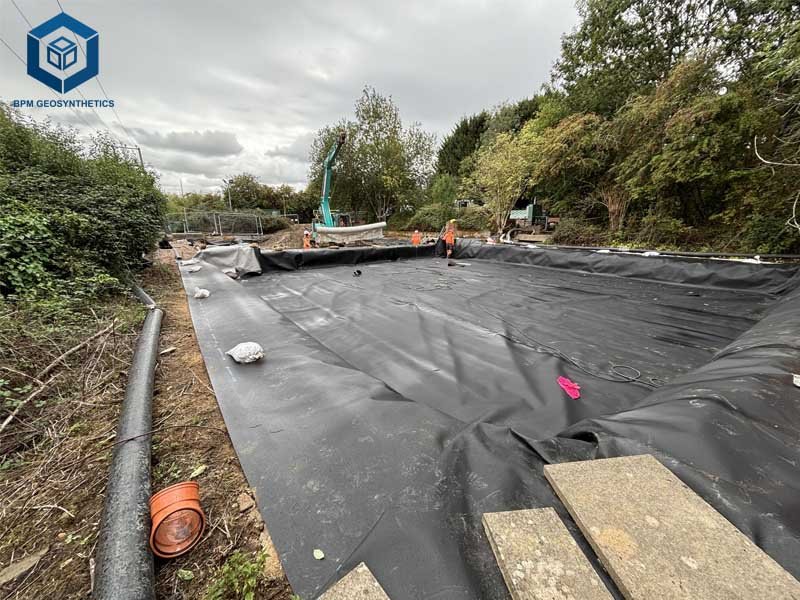
6. Maintenance Strategies for HDPE Geomembranas
Proactive stewardship prolongs efficacy by 40%. Bi-annual NDT scans detect >3% thinning; flush effluents quarterly to forestall biofouling (90% mitigation). Recoat exposed seams with 200-micron epoxies annually in corrosives.
6.1 HDPE Geomembranas – Inspection Protocols
Ultrasonic gauging (<0.1 mm/year wear); drone thermography flags 72-hour anomalies.
6.2 HDPE Geomembranas – Repair and Monitoring
Hot-air patches restore 95% integrity; IoT sensors log OIT drops, curbing failures 50%.
6.3 HDPE Geomembranas – Storage Best Practices
Climate-control (<40% RH) averts microbial ingress; vertical racking preserves 100% flatness.
Grounded in ASTM D5887, these tactics sustain 70-year viabilities.
7. Conclusion
In 2025’s imperative for fortified containment amid regulatory evolution, HDPE geomembranas are linchpins of ecological and operational resilience—from Solmax’s seismic prowess to BPM’s precision Smooth Liner. Our top 10 distill tensile titans (80 kN/m max), permeation virtuosos (<0.01 ml/m²/day), and adaptive alloys, corroborated by ASTM quanta and deployments affirming 50+ year tenures.
Anchor choices in app metrics—puncture bulwarks, OIT sentinels, friction fulcrums—to procure shields eclipsing $100k remediation pitfalls. BPM Geosynthetics’ customization paradigm transmutes standards to symphonies of site synergy, nurturing enduring legacies. Embrace these eruditions: armor your endeavors with datum-decreed distinction today.
Get a Custom Quote: For tailored HDPE geomembranas or OEM solutions from BPM Geosynthetics(BPM Geomembrane), submit specs—we reply in 24 hours.


