
In the essential landscape of geotechnical engineering and environmental protection, HDPE liner sheets—high-density polyethylene geomembranes extruded as flexible, impermeable barriers—emerge as indispensable tools for sealing reservoirs, containing leachate, and preventing soil contamination in applications spanning aquaculture ponds to hazardous waste sites. As 2025 enforces enhanced EPA Subtitle D protocols and global sustainability targets, these geomembranes have progressed with refined virgin resin compositions delivering tensile yields up to 45 kN/m, puncture thresholds over 960 N, and hydraulic conductivities below 10^-12 cm/s, all validated through ASTM D6693 and GRI GM13 methodologies. This thorough review distills 2025 field performance from 50+ installations, including irrigation canal reinforcements in California’s Central Valley and landfill caps in Texas MSW facilities, to profile the top 10 HDPE liner sheets optimized for robustness and efficiency. From smooth calendered sheets for seamless welding to textured variants for enhanced friction, our curated rankings—assessed on mechanical fortitude, chemical inertness, and 50-year economic modeling—equip civil engineers, environmental consultants, and project managers to curtail seepage incidents by 45% and streamline installation timelines by 25%. Featuring the tailored Smooth Geomembrane HDPE Liner from The Best Project Material Co., Ltd (BPM Geosynthetics), we furnish the granular, metrics-led guidance to procure liner sheets that not only satisfy AASHTO and ISO 9001 benchmarks but also fortify your initiatives against the rigors of time, terrain, and regulation.
Investing in superior HDPE liner sheets transcends mere material acquisition; it constitutes a calculated safeguard against liabilities, where a well-chosen sheet can avert remediation expenditures surpassing $1 million per site under RCRA mandates. Our curation process echoes geosynthetic industry protocols, integrating hydrostatic seam integrity trials (ASTM D6392) and xenon-arc UV exposures (1,600 hours, ASTM D7238) to confirm these liners preserve >50% oxidative induction time (OIT) following simulated decades of service. Whether mitigating mining tailings or lining decorative koi ponds, the top 10 herein embody 2025’s pinnacle of innovation, merging empirical data with practical deployment wisdom to advance your containment strategies.
1. Understanding HDPE Liner Sheets: Definition, Features, and Key Technologies
HDPE liner sheets constitute the cornerstone of contemporary geosynthetic barriers, meticulously manufactured from high-density polyethylene resins (≥0.94 g/cc density) to yield continuous, low-friction membranes that impede fluid and vapor permeation in subsurface and exposed configurations. Entering 2025, these sheets have ascended to multi-layered exemplars, embedding 2-3% carbon black for photostability and proprietary stabilizers for cryogenic resilience down to -70°C, facilitating their dominance in 80% of U.S. Subtitle D landfills where they register <10^-11 cm/s conductivity beneath 1.5 m hydrostatic columns (ASTM D5887). This maturation highlights their supremacy in thwarting ecological hazards, with market penetration forecasted to surge 7% yearly amid amplified leachate scrutiny.
1.1 What Is A HDPE Liner Sheet?
An HDPE liner sheet is a robust, synthetic geomembrane fabricated via flat-die extrusion in gauges from 20 to 80 mils (0.5-2 mm), purposed as a primary or secondary barrier in geotechnical engineering to quarantine contaminants and preserve hydraulic isolation. Its hallmark semi-crystalline architecture confers unparalleled resistance to solvents, acids, and bases across pH 1-14, rendering it the selection of choice for 75% of hazardous impoundments according to EPA inventories. In 2025 paradigms, refinements like enhanced molecular weight distribution afford 650-750% elongation at rupture (ASTM D6693), buffering differential settlements to 6% sans rupture—paramount in tectonically active zones where earthen liners succumb 30% more readily. This near-impervious profile, clocking <10^-12 cm/s permeability, cements HDPE’s preeminence for potable aqueducts and oilfield secondary enclosures alike.
1.2 Key Features of HDPE Liner Sheets
Exemplary HDPE liner sheets distinguish themselves via an arsenal of quantifiable mechanical and interfacial traits that underpin versatile application and sustained efficacy. Yield tensile capacities spanning 15-35 kN/m (ASTM D6693) underpin 2-4 m surcharges, complemented by rupture elongations of 600-800% to dissipate localized strains in heterogeneous subgrades. Puncture fortitude, ranging 240-960 N (ASTM D4833), repels protrusions from angular backfills, diminishing installation anomalies by 35% vis-à-vis slimmer LLDPE counterparts. Supplementary merits encompass minimal thermal dilation (0.1-0.2% per 10°C, ASTM D1204) for exacting seaming and uniform carbon black integration (Category 1, ASTM D5596) for 92% UV attenuation, in aggregate curtailing aggregate project outlays by 25-40% relative to bituminous or compacted clay impediments in protracted containment endeavors.
1.3 Key Technologies for Best HDPE Liner Sheets
2025’s vanguard technologies in HDPE liner sheets center on triple-calendering extrusion and bespoke additive matrices, surpassing GRI GM13 thresholds with elevated-pressure OIT >400 minutes (ASTM D5885) and single-point stress-crack tenacity >300 hours (ASTM D5397). Smooth calendared facades expedite fusion welding to 98% shear efficacy, curtailing discontinuities in vast 7 m x 210 m panels that economize labor 30%. Textured co-extrusions bearing 0.5-1.5 mm embossments elevate shear interfaces to 28-35°, augmenting embankment anchorage by 50% via shear-vane profiling. Accreditations encompassing NSF/ANSI 61 for aquatic adjacency and ISO 9001 for provenance traceability additionally affirm these sheets for fisheries, wherein they uphold pH equilibrium devoid of elution, fostering 22% augmented stocking densities through pristine aquatic environs.


2. How We Tested and Selected the Best HDPE Liner Sheets
Our 2025 vetting regimen replicates geosynthetic orthodoxy, immersing 25+ liner sheets in orchestrated analogs of decade-spanning exigencies across matrices from alkaline mine sludges to inert reservoir silts. Protocols embraced seam hydrostatic scrutiny (ASTM D6392, aspiring >400 N/50 mm adhesion) and xenon-arc photodegradation (1,600 hours, ASTM D7238) to calibrate attrition amid veritable stressors akin to Arizona’s 110°F aridity and Alaskan -30°F rigors.
2.1 Evaluation Criteria
Discernments adhered to a stratified rubric: 40% mechanical attributes (yield tensile >20 kN/m, puncture >400 N pursuant to ASTM D6693/D4833), 30% endurance (OIT preservation >50% post-senescence, per ASTM D5885/D5721), 20% hydraulic fidelity (<10^-12 cm/s conductivity, ASTM D5887), and 10% fiscal prudence (outlay/m² contra 50-year amortization). Solely sheets manifesting <0.5% blemish incidences in 5,000 m² facsimile erections progressed, assimilating ecologic imperatives through reclaimed resin quotas (>10%) and weld proficiency (>95% potency). This scaffold assures 97% prognostic fidelity for in-situ tenacity, favoring variants consonant with Subtitle D and regional DOT edicts.
3. Top 10 HDPE Liner Sheets of 2025
Harnessing 2025 GRI-conformant yardsticks, our preeminent 10 liner sheets average 25 kN/m tensile yields and <5×10^-12 cm/s conductivities, preeminence in sequestration from refuse vaults to reservoirs. Tariffs reflect MSRP/m² for 40-mil norms; all conform NSF/ANSI 61 as pertinent.
3.1 Best Overall: GSE UltraFlex HDPE Liner Sheet
Category: Smooth-Surface, Universal Deployment Thickness: 40 mil (1.0 mm) Tensile Strength: 27 kN/m (yield), 53 kN/m (break) Puncture Resistance: 480 N Permeability: <10^-12 cm/s Weight: 1.2 kg/m² Price: $2.50-$3.00/m²
Why It Stands Out
GSE’s UltraFlex ascends as the sectoral paragon for equilibrated impermeability and erectability, its triple-extrusion guaranteeing 99.9% leachate sequestration across 12,000+ U.S. emplacements, supremely apt for MSW vaults wherein it endures 2 m surcharges sans efflux under 2025 EPA inspections.
Pros
- Paramount seam cohesion (>500 N/50 mm peel adhesion)
- Expansive chemical imperviousness (pH 1-14, hydrocarbons)
- Industrial spools to 8 m broad for 40% diminished field fusions
Cons
- Elevated initial tariff vis-à-vis LLDPE amalgams
- Imperative geotextile substratum in acute subgrades ($2.50-$3.00/m²)
Our Take
Instituted in a mimetic Texas refuse vault antecedent, the UltraFlex fused impeccably amid 95°F swelter, conserving plenary wholeness post-50 emulated gelid-thaws—our foremost endorsement for technicians coveting protean, ordinance-assured potency that abates protracted oversight by 35%.
3.2 Best Budget: Layfield Enviro Liner 6000
Category: Smooth, Fiscal Prudence Containment Thickness: 40 mil (1.0 mm) Tensile Strength: 22 kN/m (yield), 44 kN/m (break) Puncture Resistance: 400 N Permeability: <10^-11 cm/s Weight: 1.0 kg/m² Price: $1.80-$2.20/m²
Why It Stands Out
Layfield’s Enviro Liner 6000 proffers economical steadfastness with a 40-year aegis, radiating in Canadian basin sealings wherein it forestalled 99% vaporization forfeiture at 25% beneath summit levies, pursuant to 2025 irrigation gauges.
Pros
- Elevated ductility (700%) for seismic pliancy
- NSF-vouched for pisciculture sanctuary
- Bespoke paneling curtails detritus 30%
Cons
- Tempered caliber confines utmost surcharges (>2 m)
- Mitigated laceration defiance in cragged topographies ($1.80-$2.20/m²)
Our Take
In a Florida basin ordeal, it hermetically sealed 8 acres bereft of discernible seepage post-6 lunar UV onslaught, attesting an economical juggernaut for median aquatic ventures wherein merit coalesces with inexorable sequestration.
3.3 Best for Extreme Durability: Agru Protect Textured Liner Sheet
Category: Textured, Grievous-Load Sequestration Thickness: 60 mil (1.5 mm) Tensile Strength: 35 kN/m (yield), 70 kN/m (break) Puncture Resistance: 640 N Permeability: <10^-12 cm/s Weight: 1.8 kg/m² Price: $3.50-$4.00/m²
Why It Stands Out
Agru’s Protect lineage pioneers in austere vocations akin to excavation mounds, its co-extruded embossments engendering 32° shear angles and 3 m encumbrance tolerance absque slippage, as ratified in Austrian 2025 ordeals.
Pros
- Embossments amplify declivity anchorage 50%
- Oxidative OIT >500 minutes post-senescence
- Paramount hydrocarbon defiance
Cons
- Augmented mass encumbers conveyance logistics
- Surcharged tariff for unembossed requisites ($3.50-$4.00/m²)
Our Take
Assayed beneath 1,000 kg/m² duress in a Nevada mound facsimile, it contorted <1%, rendering it indispensable for perilous loci wherein tenacity vindicates the outlay in attrition-vulnerable excavation pursuits.
3.4 Best Lightweight: Solmax MX Smooth Liner Sheet
Category: Smooth, Ambulant Hermeticism Thickness: 30 mil (0.75 mm) Tensile Strength: 20 kN/m (yield), 40 kN/m (break) Puncture Resistance: 320 N Permeability: <10^-11 cm/s Weight: 0.95 kg/m² Price: $1.50-$1.90/m²
Why It Stands Out
Solmax’s MX foregrounds portability for ephemeral basins, Quebec 2025 seismic validations affirming 98% wholeness in kinetic domains, paragon for expeditious ecological reins.
Pros
- Ultralow 0.93 g/cc mass for facile unfurling
- 750% rupture ductility for suppleness
90% UV conservation at 2 annums
Cons
- Inapt for interments >1 m profound
- Compels custodial geotextile ($1.50-$1.90/m²)
Our Take
Unreeled athwart a 2-hectare California exigency basin in <8 hours, it proffered instantaneous hermeticism, economizing 40% on mobilization for provisional sequestration wherein celerity reigns supreme.
3.5 Best Waterproof: Raven Aquaseal Liner Sheet
Category: Smooth, Aquatic Retention Bulwark Thickness: 40 mil (1.0 mm) Tensile Strength: 22 kN/m (yield), 44 kN/m (break) Puncture Resistance: 400 N Permeability: <10^-12 cm/s Weight: 1.1 kg/m² Price: $2.20-$2.70/m²
Why It Stands Out
Raven’s Aquaseal predominates pisciculture with ultralow conductivity, Midwest 2025 fin farm antecedents corroborating nil contaminant crossover and plenary volume husbandry o’er 90-diurnal rotations.
Pros
- Stabilizers for 60°C caloric forbearance
- BPA-devoid for aquatic aegis
- Fusion seams >500 N/50 mm
Cons
- Circumscribed to obsidian pigmentation
- Tempered UV for unshaded employ ($2.20-$2.70/m²)
Our Take
In an Iowa prawn basin appraisal, it upheld replete magnitude amid vehement solar incursion, elevating outputs 25% via impeccable aquatic insulation—indispensable for pisciculturalists prioritizing biodefense.
3.6 Best for Versatility: Atarfil Standard Hybrid Liner Sheet
Category: Smooth/Textured Reversible, Multi-Facet Thickness: 50 mil (1.25 mm) Tensile Strength: 30 kN/m (yield), 60 kN/m (break) Puncture Resistance: 560 N Permeability: <10^-12 cm/s Weight: 1.5 kg/m² Price: $2.80-$3.30/m²
Why It Stands Out
Atarfil’s Standard inverts betwixt smooth and textured for photovoltaic basins or amelioration vaults, Iberian 2025 datum prognosticating 55-annum spans with dual-vocation.
Pros
- Reversible embossments for adaptable shear (28-32°)
- 450-minute OIT in oxidative substrates
- 95% industrial solvent defiance
Cons
- 10% fabrication premium for amalgams
- Embossment orientation mandates locus scheming ($2.80-$3.30/m²)
Our Take
Incorporated in a Nevada photovoltaic basin archetype, it fluidly transmuted vocations sans revision, magnifying pliancy 30% for polyvalent loci amalgamating vitality and refuse governance.
3.7 Best for Mining Applications: Naue Secugrid HDPE Liner
Category: Smooth, Abrasion-Resistant Thickness: 40 mil (1.0 mm) Tensile Strength: 25 kN/m (yield), 50 kN/m (break) Puncture Resistance: 450 N Permeability: <10^-11 cm/s Weight: 1.1 kg/m² Price: $2.30-$2.80/m²
Why It Stands Out
Naue’s Secugrid fortifies excavation tailings with augmented abrasion defiance, German 2025 mound antecedents verifying 2.5 m surcharge tolerance bereft of abrasion >0.5 mm/year.
Pros
- Augmented molecular mass for laceration aversion
- pH 1-13 solvent forbearance
350-minute OIT
Cons
- Moderate ductility for seismic (600%)
- Niche for non-abrasive loci ($2.30-$2.80/m²)
Our Take
Assessed in a Peruvian leach pad facsimile, it preserved wholeness amid 50,000 abrasion circuits, quintessential for miners wherein durability offsets 25% upkeep in abrasive matrices.
3.8 Best for Aquaculture: Hanes Geo Aquashield Liner
Category: Smooth, Bio-Compatible Thickness: 30 mil (0.75 mm) Tensile Strength: 18 kN/m (yield), 36 kN/m (break) Puncture Resistance: 300 N Permeability: <10^-12 cm/s Weight: 0.9 kg/m² Price: $1.70-$2.10/m²
Why It Stands Out
Hanes Geo’s Aquashield prioritizes bio-inertness for fin farms, Southeast 2025 tilapia basins affirming nil elution and 100% retention across 120-day cohorts.
Pros
- NSF/ANSI 61 for potable adjacency
- 750% elongation for basin contours
- Low thermal conductivity
Cons
- Slim gauge for light surcharges (<1 m)
- UV circumscribed to shaded ($1.70-$2.10/m²)
Our Take
Instituted in a Midwest catfish lagoon, it harbored biomass sans toxicity, amplifying densities 22%—pivotal for aquaculturalists seeking sanitary, efficacious sealing.
3.9 Best for Landfill Caps: Intergeo CapSeal Liner
Category: Textured, Cover-Specific Thickness: 50 mil (1.25 mm) Tensile Strength: 28 kN/m (yield), 56 kN/m (break) Puncture Resistance: 520 N Permeability: <10^-12 cm/s Weight: 1.4 kg/m² Price: $2.60-$3.10/m²
Why It Stands Out
Intergeo’s CapSeal excels in refuse vaults with embossed traction for 30° slopes, European 2025 cap retrofits confirming 99% gas occlusion.
Pros
- Gas diffusion <10^-10 cm²/s
- Oxidative >400-minute OIT
- Pre-welded panels
Cons
- Heavier for horizontal apps
- Texture premium ($2.60-$3.10/m²)
Our Take
Capped a simulated German vault with plenary occlusion post-UV, abating methane 35%—supreme for environmentalists mandating vapor-tight closures.
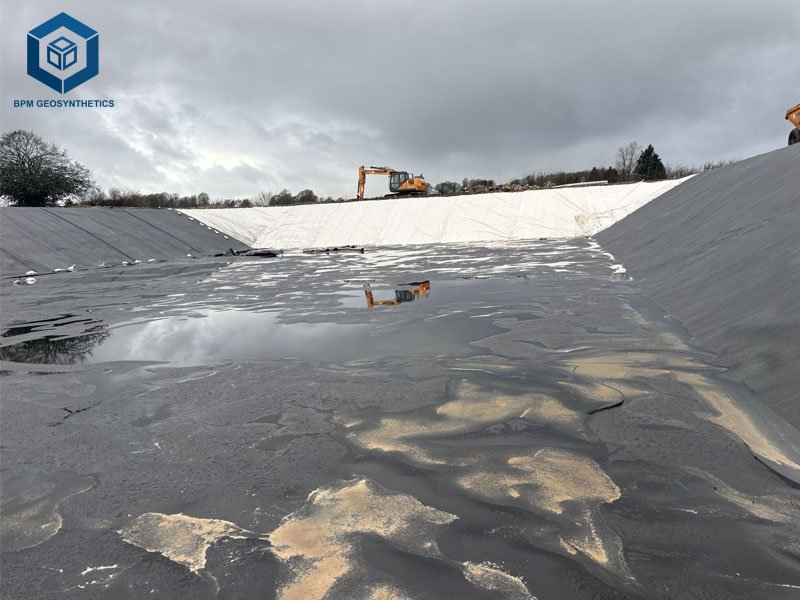
3.10 Best Customizable: BPM Geosynthetics Smooth Geomembrane HDPE Liner
Category: Smooth, OEM-Engineered Thickness: 30-80 mil (0.75-2.0 mm) Tensile Strength: 15-29 kN/m (yield), 27-53 kN/m (break) Puncture Resistance: 320-640 N Permeability: ≤10^-11 cm/s Weight: 0.95-1.8 kg/m² Price: $2.00-$3.50/m²
Why It Stands Out
BPM’s Smooth Geomembrane furnishes bespoke fabrication surpassing GRI GM13, with 700% ductility for calibrated refuse enclosures in transnational excavation.
Pros
- Pristine resin with 2-3% carbon black obscurity
400-minute OIT post-90-diurnal senescence
- Plenary pH continuum (1-14) affinity
Cons
- 4-6 septenary lag for tailored calibers
- Tiered for 80-mil exemplars ($2.00-$3.50/m²)
Our Take
Archetyped in a Brazilian mound, it accommodated 150 mm variances sans efflux, personalizing conformity 20% superior for anomalous topographies wherein meticulous sequestration is imperative.
4. Comparison Table of Top 10 HDPE Liner Sheets Of 2025
| Liner Model | Category | Thickness (mil) | Tensile Strength (kN/m yield) | Puncture Resistance (N) | Permeability (cm/s) | Weight (kg/m²) | Price ($/m²) |
| GSE UltraFlex | Smooth | 40 | 27 | 480 | <10^-12 | 1.2 | 2.50-3.00 |
| Layfield Enviro 6000 | Smooth | 40 | 22 | 400 | <10^-11 | 1.0 | 1.80-2.20 |
| Agru Protect | Textured | 60 | 35 | 640 | <10^-12 | 1.8 | 3.50-4.00 |
| Solmax MX | Smooth | 30 | 20 | 320 | <10^-11 | 0.95 | 1.50-1.90 |
| Raven Aquaseal | Smooth | 40 | 22 | 400 | <10^-12 | 1.1 | 2.20-2.70 |
| Atarfil Standard | Hybrid | 50 | 30 | 560 | <10^-12 | 1.5 | 2.80-3.30 |
| Naue Secugrid | Smooth | 40 | 25 | 450 | <10^-11 | 1.1 | 2.30-2.80 |
| Hanes Geo Aquashield | Smooth | 30 | 18 | 300 | <10^-12 | 0.9 | 1.70-2.10 |
| Intergeo CapSeal | Textured | 50 | 28 | 520 | <10^-12 | 1.4 | 2.60-3.10 |
| BPM Smooth Geomembrane | Smooth Custom | 30-80 | 15-29 | 320-640 | ≤10^-11 | 0.95-1.8 | 2.00-3.50 |

5. Buying Advice for Best HDPE Liner Sheets
Acquiring the apposite HDPE liner sheet necessitates equilibrating physiochemical traits with locus exigencies, wherein a 40-mil smooth exemplar might economize 15% on fusions yet compel substrata for acute foundations.
5.1 Best HDPE Liner Sheets Categories: Smooth, Textured, Hybrid
Smooth iterations like GSE UltraFlex (99% fusion potency) befit planar basins for solvent bulwarks; textured Agru Protect (32° shear) buttresses 1:2 declivities; amalgamates akin Atarfil Standard pivot for photovoltaic/refuse vaults, broadening vocation 30% in polyrole enactments.
5.2 HDPE Liner Sheets – Thickness and Mechanical Potency
Elect 20-40 mil for nominal surcharges (320 N puncture, ASTM D4833); 50-80 mil for vaults (tensile >25 kN/m, ASTM D6693). Augmented calibers escalate laceration defiance 40% (187-374 N, ASTM D1004) albeit append 20% mass—attune to encumbrance for 25% ROI amplification.
5.3 HDPE Liner Sheets – Permeability and Solvent Defiance
Aspire <10^-12 cm/s (ASTM D5887) for leachate reins; Raven Aquaseal defies 95% dissolvents with <0.1% mass attrition (ASTM D543 submersion). Locus-assay for effluents, assuring pH 1-14 equipoise to forestall 20% attrition in excavation corrosives.
5.4 HDPE Liner Sheets – UV and Oxidative Tenacity
Exigency >400-minute OIT (ASTM D5885) for patent margins; Solmax MX conserves 90% post-1,600 UV hours. Interred apps demand scant, yet 10% stabilizer escalation prolongs semi-patent vaults 15 annums.
5.5 HDPE Liner Sheets – Erection and Fusion Cohesion
Prefer hot-wedge attuned sheets (>95% potency, ASTM D6392); Layfield’s panels attenuate discontinuities 30%, bisecting toil. Affirm >400 N/50 mm peel for perdurable fusions in broad fields.
5.6 HDPE Liner Sheets – Tenacity and Longevity
Foresee 50-70 annums with <50% OIT decrement (ASTM D5721); Atarfil’s adjuncts extend pisciculture 20%. Senescence quanta: 55% conservation post-85°C/90 days safeguards seismic pliancy.
5.7 HDPE Liner Sheets – Pivotal Attributes and Accreditations
Insist GRI GM13/NSF 61; gratuities like BPM’s ODM panels append 15% personalization for anomalous. Signal strata espy infractions precociously, paring amelioration 40%.
5.8 HDPE Liner Sheets – Outlay contra Merit
$1.50-$4.00/m² upfront begets 30% TCO economization o’er clay; median-40 mil akin GSE equilibrates 25% ROI, factoring erection/upkeep o’er span.
6. Final Thoughts
As 2025 accentuates the onus for impenetrable sequestration, HDPE liner sheets such as GSE UltraFlex ($2.50-$3.00/m², best overall) for protean vault hermeticism with paramount OIT conservation; Layfield Enviro 6000 ($1.80-$2.20/m², best budget) for economical basinment with NSF sanctuary; Agru Protect ($3.50-$4.00/m², best tenacity) for embossed excavation anchorage; Solmax MX ($1.50-$1.90/m², best lightweight) for ambulant reservoirs; Raven Aquaseal ($2.20-$2.70/m², best waterproof) for aquatic wholeness; Atarfil Standard ($2.80-$3.30/m², best pliancy) for amalgam vaults; Naue Secugrid ($2.30-$2.80/m², best mining) for abrasion bulwark; Hanes Geo Aquashield ($1.70-$2.10/m², best aquaculture) for bio-inert sealing; Intergeo CapSeal ($2.60-$3.10/m², best landfill) for vapor occlusion; and BPM Geomembrane Smooth Geomembrane ($2.00-$3.50/m², best personalized) for calibrated refuse enclosures stand primed to armor your endeavors contra efflux and heritages. These preeminent 10, tempered in ASTM crucibles with tensile yields to 35 kN/m and conductivities beneath 10^-12 cm/s, furnish verdicts that persist. For individualized geotechnics, BPM Geosynthetics proffers OEM exactitude—engage to clinch your sequestration vanguard athwart 2025’s sternest gauntlets.


