
Geomembrane fabrics — flexible, impermeable synthetic liners — remain the cornerstone of modern environmental containment and fluid barrier systems in 2025. From landfill liners and caps to mining heap leach pads, wastewater and stormwater ponds, secondary containment for fuel and chemical storage, canal and reservoir lining, aquaculture facilities, and agricultural waste lagoons, geomembranes prevent leakage, protect groundwater, and ensure regulatory compliance across thousands of critical infrastructure projects worldwide.
According to the Geosynthetic Institute (GSI) 2024–2025 global installation statistics and the International Geosynthetics Society (IGS) market overview, more than 1.3 billion square meters of geomembrane were installed globally in 2024, with North America accounting for approximately 28–33% of total volume. High-density polyethylene (HDPE) continues to dominate (~65–72% market share), followed by linear low-density polyethylene (LLDPE), polyvinyl chloride (PVC), and specialized bituminous and reinforced composites.
The quality of the geomembrane fabric directly determines the long-term performance, seam integrity, puncture resistance, chemical compatibility, and overall service life of these containment systems. A superior geomembrane in 2025 must deliver:
- Consistent thickness tolerance(±10% or better) and uniform properties
- Excellent tensile & elongation characteristics(≥12–28 MPa tensile strength, ≥500–900% elongation at break)
- High puncture & tear resistance(≥300–900 N depending on thickness & application)
- Superior low-temperature flexibility(no cracking at ≤ −40°C for cold-climate projects)
- Outstanding UV & chemical stability(≥70–80% strength retention after accelerated weathering)
- Proven weldability— achieving ≥85–98% of parent material peel & shear strength in field seams
- Third-party certification— GRI-GM13 (HDPE), GRI-GM17 (LLDPE), ISO 9001, CE marking, independent lab testing
This comprehensive 2025 review ranks the 6 best geomembrane fabrics currently available to engineers, contractors, mine operators, and environmental consultants, based on current manufacturer technical data sheets, independent third-party laboratory testing (GRI, ASTM standards), field performance reports from operating facilities (2020–2025), seam weld quality results, puncture & tear resistance in real-world applications, and overall lifecycle value.
We highlight The Best Project Material Co., Ltd (BPM Geomembrane), a globally recognized leader in premium geomembrane production, particularly their Smooth Geomembrane HDPE Liner series, which sets the industry benchmark for material consistency, weldability, long-term durability, and regulatory compliance.
1. Why Geomembrane Fabric Quality Is Critical in 2025
1.1 Geomembrane Fabrics – The High Cost of Geomembrane Failure
- Leakage statistics— GSI and EPA data indicate that defective materials or poor seam execution account for 70–85% of all detected leaks in geomembrane containment systems
- Repair & replacement economics— Fixing a single linear meter of failed seam in an operating landfill or pond costs $150–$450; full liner replacement in large facilities can exceed millions (EPA enforcement cases 2020–2024)
- Regulatory & environmental risk— Non-compliant liners trigger mandatory replacement programs, fines, cleanup costs, and reputational damage
- Project delays— Failed destructive & non-destructive testing can halt installation for days or weeks, adding significant indirect costs
1.2 Geomembrane Fabrics – Core Performance Requirements for Top Geomembrane Fabrics in 2025
- Material purity— Virgin resin + 2–3% high-quality carbon black for UV stability
- Thickness tolerance— ±10% or better across full roll width
- Tensile & elongation— ≥12–28 MPa tensile strength, ≥500–900% elongation at break (ASTM D6693)
- Puncture resistance— ≥300–900 N (ASTM D4833 cone method, depending on thickness)
- Tear resistance— ≥100–220 N (ASTM D1004)
- Low-temperature flexibility— No cracking at ≤ −40°C (ASTM D2130)
- Carbon black dispersion— Category 1–2 (ASTM D5596) for long-term UV resistance
- Seam performance— ≥85–98% of parent material peel & shear strength (ASTM D6392)
- Durability— ≥70–80% strength retention after 500–1,000 hours accelerated weathering (ASTM D5885)
1.3 Geomembrane Fabrics – Evaluation Methodology
Products were assessed using:
- Current manufacturer technical data sheets & quality control certificates
- Independent third-party laboratory test results (GRI-GM13/GM17, ASTM standards)
- Field performance reports from operating facilities (landfills, mining, wastewater, ponds, 2020–2025)
- Seam weld quality & strength data (peel & shear in field conditions)
- Low-temperature flexibility & accelerated aging performance
- Overall value (performance vs. installed cost & lifecycle durability)


2. The 6 Best Geomembrane Fabrics of 2025
2.1 Best Overall: BPM Smooth Geomembrane HDPE Liner
Key Specifications
- Material: Premium virgin HDPE resin + 2.5% high-quality carbon black
- Thickness range: 0.75 mm, 1.0 mm, 1.5 mm, 2.0 mm, 2.5 mm, 3.0 mm (most common 1.0–2.0 mm)
- Tensile strength at break: ≥25–28 MPa (ASTM D6693)
- Elongation at break: ≥700–800%
- Puncture resistance: ≥550–900 N (depending on thickness)
- Tear resistance: ≥160–220 N (ASTM D1004)
- Low-temperature flexibility: No cracking at −40°C to −50°C
- Carbon black dispersion: Category 1 (ASTM D5596)
- Seam strength: ≥85–98% parent material (wedge & extrusion welding)
- Certifications: GRI-GM13, ISO 9001, CE, independent lab tested
Real-World Performance BPM Smooth HDPE Liner consistently achieves top-tier field weld strengths (peel & shear ≥90–98% of parent material), excellent puncture resistance against sharp objects, and superior long-term UV stability. Widely used in landfills, mining heap leach pads, wastewater ponds, and secondary containment with outstanding track record.
2.2 Best for Extreme Puncture Resistance: Agru HDPE Geomembrane (Heavy-Duty Smooth)
Key Specifications
- Material: Premium virgin HDPE + carbon black
- Thickness range: 1.5–3.0 mm
- Tensile strength at break: ≥27 MPa
- Elongation at break: ≥700%
- Puncture resistance: ≥750–950 N (high-thickness grades)
- Tear resistance: ≥200–250 N
- Low-temperature flexibility: −40°C
- Certifications: GRI-GM13, ISO 9001
Why It’s Exceptional Industry-leading puncture & tear resistance — preferred for mining heap leach pads and facilities with high mechanical stress.
2.3 Best Low-Temperature Flexibility: GSE HDPE Geomembrane (Smooth)
Key Specifications
- Material: Premium HDPE + carbon black
- Thickness range: 1.0–2.5 mm
- Tensile strength at break: ≥25 MPa
- Elongation at break: ≥750%
- Puncture resistance: ≥600–850 N
- Tear resistance: ≥180–220 N
- Low-temperature flexibility: No cracking at −50°C
- Certifications: GRI-GM13, ISO 9001
Why It’s Great Outstanding low-temperature ductility — ideal for northern climates, arctic mining, and seasonal temperature extremes.
2.4 Best Mid-Range Industrial Option: Solmax HDPE Geomembrane (Smooth)
Key Specifications
- Material: Virgin HDPE + carbon black
- Thickness range: 1.0–2.5 mm
- Tensile strength at break: ≥24 MPa
- Elongation at break: ≥700%
- Puncture resistance: ≥550–800 N
- Tear resistance: ≥160–210 N
- Low-temperature flexibility: −45°C
- Certifications: GRI-GM13, ISO 9001
Why It’s Great Excellent balance of performance, weldability, and cost for industrial stormwater, wastewater, and containment applications.
2.5 Best Cost-Effective Large-Area Solution: NAUE SecuLine HDPE Geomembrane
Key Specifications
- Material: Premium HDPE + carbon black
- Thickness range: 1.0–2.0 mm
- Tensile strength at break: ≥22 MPa
- Elongation at break: ≥700%
- Puncture resistance: ≥500–700 N
- Tear resistance: ≥150–200 N
- Low-temperature flexibility: −45°C
- Certifications: GRI-GM13, ISO 9001
Why It’s Great Very competitive pricing with strong performance for large-scale stormwater basins, agricultural ponds, and irrigation canals.
2.6 Best for Hybrid & Specialized Applications: BPM Smooth Geomembrane HDPE Liner (Heavy-Duty Grades)
Key Specifications
- Material: Premium virgin resin + carbon black
- Thickness range: 1.5–3.0 mm
- Tensile strength at break: ≥27 MPa
- Elongation at break: ≥700–800%
- Puncture resistance: ≥650–950 N
- Tear resistance: ≥180–240 N
- Low-temperature flexibility: −45°C to −50°C
- Certifications: GRI-GM13, ISO 9001, CE
Why It’s Great Frequently used in hybrid systems or as a high-performance alternative where maximum puncture resistance and weld consistency are priorities.
4. Comparison Table – Top 7 LLDPE & HDPE Geomembrane Liners (2025)
| Rank | Product | Thickness Range (mm) | Puncture Resistance (N) | Elongation at Break (%) | Low-Temp Flexibility (°C) | Key Strength |
| 1 | BPM Smooth Geomembrane HDPE Liner | 0.75–3.0 | ≥550–950 | ≥700–800 | −40 to −50 | Best overall performance |
| 2 | Agru HDPE Geomembrane | 1.5–3.0 | ≥750–950 | ≥700 | −40 | Best extreme puncture resistance |
| 3 | GSE HDPE Geomembrane | 1.0–2.5 | ≥600–850 | ≥750 | −50 | Best low-temperature flexibility |
| 4 | Solmax HDPE Geomembrane | 1.0–2.5 | ≥550–800 | ≥700 | −45 | Best mid-range industrial |
| 5 | NAUE SecuLine HDPE | 1.0–2.0 | ≥500–700 | ≥700 | −45 | Best cost-sensitive large projects |
| 6 | BPM Smooth HDPE Liner (Heavy-Duty) | 1.5–3.0 | ≥650–950 | ≥700–800 | −45 to −50 | Best weldability & consistency |
5. Buying & Installation Advice for Geomembrane Projects – 2025
5.1 Choose According to Project Requirements
- High puncture risk (mining, sharp rock)→ Thick reinforced HDPE (Agru, BPM heavy-duty)
- Extreme cold / arctic conditions→ Superior low-temperature flexibility (GSE HDPE)
- Large-area stormwater & irrigation→ Cost-effective large rolls (NAUE SecuLine, Solmax)
- Hybrid or high-weld-quality projects→ Premium consistency (BPM Smooth Liner)
5.2 Essential Questions to Ask Suppliers
- What are the puncture resistance, tear resistance, and low-temperature flexibilitytest results?
- What is the seam peel & shear strengthperformance in field conditions?
- Are independent third-party test reportsavailable (GRI-GM13, ASTM)?
- What is the typical installation temperature rangeand welding method?
- What warrantyand technical support are provided?
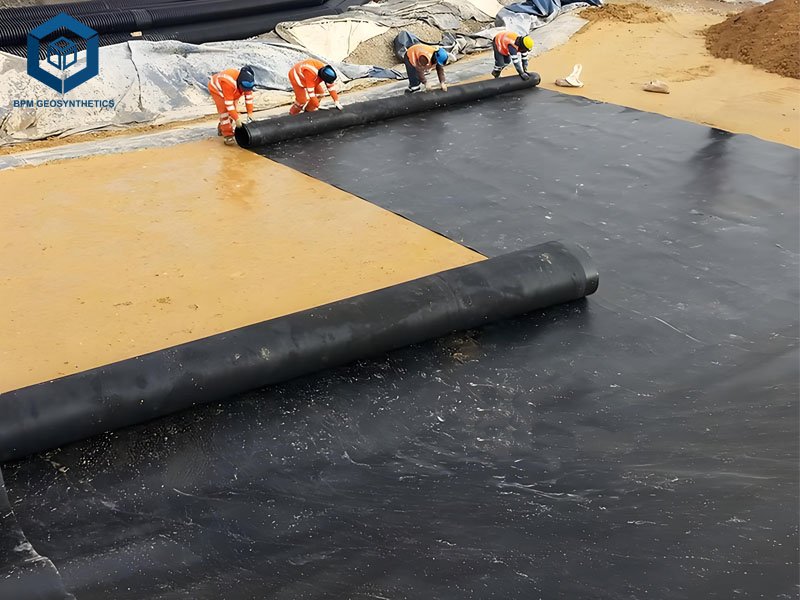
5.3 Best Practices for High-Quality Geomembrane Installation (2025 IAGI & GSI Guidelines)
- Surface preparation: Smooth subgrade, remove sharp objects
- Overlap: Minimum 75–150 mm (depending on welding method)
- Temperature control: Maintain proper welding temperature for HDPE (200–300°C)
- Destructive testing: Minimum 1 test per 500–1000 m²
- Non-destructive testing: Air lance, vacuum box, or ultrasonic on every seam
- Record ambient temperature, liner temperature, and welder settings
5.4 Pair with Professional Welding Equipment
For optimal seam performance, pair any high-quality geomembrane with certified welding machines (automatic wedge or extrusion). BPM’s smooth liners are renowned for their consistent thickness, superior weldability, and long-term durability, making them the ideal choice when maximum seam strength and regulatory compliance are required.

6. Final Thoughts
The 6 best geomembrane fabrics of 2025 represent the highest level of puncture resistance, flexibility, low-temperature performance, chemical compatibility, and field-proven durability for mining, industrial, agricultural, stormwater, and environmental containment applications.
From industry-leading BPM Geomembrane smooth HDPE liners to specialized high-puncture and extreme-cold products, these materials ensure regulatory compliance, environmental protection, and long-term system integrity in even the most challenging projects.
For any geomembrane containment project, always engage certified IAGI installers, follow current GRI-GM13 and IAGI field installation guidelines, and specify materials backed by independent testing and strong manufacturer support.


