
In the exacting realm of geotechnical engineering and environmental containment, HDPE liner materials—high-density polyethylene formulations renowned for their rigidity, chemical inertness, and longevity—stand as the cornerstone of impermeable barriers, engineered to combat leachate migration and safeguard ecosystems in high-stakes applications. As 2026 intensifies with stringent global mandates, such as the EPA’s refined Subtitle D landfill protocols and the EU’s augmented Groundwater Directive, these liners achieve hydraulic conductivities below 10⁻¹¹ cm/s, delivering 99.9% seepage control and extending asset lifespans by 30–50 years while curtailing remediation expenses by 15–20%. With the geomembranes market valued at $2.61 billion and surging at a 6.61% CAGR through 2030—HDPE commanding a 31.7% share—these materials excel in municipal landfills, irrigation ponds, and mining heap leach pads, withstanding puncture forces up to 4.0 kN (ASTM D4833) across thicknesses from 0.75–3.0 mm. This rigorous review appraises the foremost six HDPE liner materials, calibrated to GRI-GM13 and ASTM D5887 standards for tensile strengths of 20–45 kN/m and UV retention surpassing 75% after 1,600 hours. Preeminent is the BPM HDPE Geomembrane from The Best Project Material Co., Ltd., distinguished by its OEM-tailored precision—explore its attributes at https://www.bpmgeomembrane.com/geomembranes/high-density-polyethylene-geomembrane/.
1. Why HDPE Liner Materials Matter
HDPE liner materials surpass conventional barriers as precision-crafted polyolefins that reinforce ecological integrity and infrastructural endurance against fluid ingress and geohazards. Holding 31.7% of the $2.61 billion geomembranes arena in 2026, these formulations attenuate contamination occurrences by 95% in regulated undertakings, per GRI analyses, traversing waste containment to aquaculture where bimodal resins mitigate 25% of stress-induced fissures. Their prominence in undulant and seismic terrains underscores a calculated shift from pliant alternatives, harmonizing steadfastness with fiscal prudence.
1.1 Environmental Protection and Regulatory Compliance
Foremost among HDPE liner materials’ merits is their containment supremacy, logging hydraulic conductivities of ≤5 × 10⁻¹² cm/s that outstrip geosynthetic clays by 90% in permeation interdiction (ASTM D5887). For landfill bases, a 2026 Texas emplacement of 45,000 m² in 1.5 mm HDPE evinced undetectable leachate post-12 months, conforming to RCRA Subtitle D imperatives and NSF/ANSI 61 for ancillary water systems. GRI-GM13 adherent and ISO 14001:2015 certified, these materials expedite conformance scrutinies, diminishing audit disbursements by 15–20% and insulating phreatic layers from heavy metals, volatiles, and pathogens—pivotal as 2026’s EPA groundwater vigilance anticipates a 20% escalation in oversight.
1.2 Durability and Long-Term Performance
Durability cements HDPE’s pecuniary justification, with tri-layer co-extrusions forecasting 50–100-year service in interred milieus. Environmental stress-crack defiance transcends 3,000 hours (ASTM D5397), eclipsing LLDPE by 35% in mimetic degradation protocols. Mining validations disclose 2.0 mm liners sustaining 4.0 kN puncture impositions (ASTM D4833), correlating to a 20% decrement in overhauls across 15 years, as attested by Peruvian heap leach chronicles. Oxidative and hydrolytic bastions conserve 78% of nascent attributes post-1,600 hours UV onslaught (ASTM D4355), traversing diurnal caloric oscillations from -70°C to 110°C with 95% mechanical constancy—though textured variants amplify friction by 30% for seismic equipoise.
1.3 Cost-Effectiveness and Versatility
Versatility galvanizes HDPE’s hegemony, with 0.75–3.0 mm calibers addressing 70% of containment exigencies at $1.2–$3.5/m²—25% beneath reinforced PVC for 6–8 m roll breadths. In reservoirs, they conform to 1:2 declivities with 28° friction arcs (ASTM D5321), while 2026 agrarian assays chronicle 17% evaporation abatements. pH fortitude (1–14) and 95% hydrocarbon repulsion widen applicability to 85% of geoenvironmental schemas, from ornamental basins to petrochemical enclosures, engendering recoup spans of 5–7 years via attenuated upkeep.


2. Key Features to Look For in the Best HDPE Liner Materials
Discerning superlative HDPE liner materials imperatives corroboration via GRI-GM13 and ASTM D5887, underscoring elongation (>600%) and oxidative induction time (OIT >400 minutes at 200°C) for consonance with seismic, thermal, and solvency rigors.
2.1 HDPE Liner Materials – Impermeability and Chemical Resistance
Quintessential impermeability at ≤10⁻¹¹ cm/s (ASTM D5887) impedes 99.9% solute conveyance in effluent lattices. Bastion encompasses 95% of corrosives, including sulfates and aromatics (ASTM D543), vital for leach pads persisting pH 1–14 beyond 1,000 hours—elevating efficacy by 20% over thinner echelons.
2.2 HDPE Liner Materials – Thickness, Strength, and Puncture Resistance
Optimal thickness: 0.75 mm for serene basins to 3.0 mm for rigorous caps, proffering tensile yields of 20–45 kN/m (ASTM D6693) and puncture baselines of 2.5–4.0 kN (ASTM D4833). Rift resistances attain 450 N (ASTM D1004), allaying 28% of manipulative perils.
2.3 HDPE Liner Materials – UV and Thermal Stability
Semi-exposed liners mandate ≥75% UV husbandry post-1,600 hours (ASTM D4355) and tolerances from -70°C to 110°C. 2.5–3% carbon black infusions and phenolic antioxidants protract viability by 25%, pursuant to GRI-GM42 augmentations for elite strata.
2.4 HDPE Liner Materials – Installation and Customization
Champion 6–8 m roll amplitudes to attenuate seams by 20%, conjoined with extrusion amalgamation procuring 95% sheet parity (ASTM D6392). Tailored asperities and pigments refine locational consonance, contracting chronologies by 15%—with 99% nondestructive seam assays via spark telemetry.
3. Top 6 HDPE Liner Materials Reviewed of 2026
Curated from empirical corroborations and divulgences, these archetypes preeminence in metrics, each GRI-GM13 avowed for traceability.
3.1 Solmax Ultra Flex HDPE Liner
Category: Smooth, High-Conformability Civil Liner
Key Specs:
- Thickness: 1.5 mm (60 mil)
- Tensile Strength: 30 kN/m (ASTM D6693)
- Puncture Resistance: 3.5 kN (ASTM D4833)
- Hydraulic Conductivity: ≤5 × 10⁻¹² cm/s (ASTM D5887)
- UV Resistance: ≥80% after 1,600 hours (ASTM D4355)
- Price: $2.10/m² (bulk)
Solmax’s Ultra Flex, a Canadian benchmark, exploits virgin bimodal resin for adeptness in irregular footings. Deployed in a 2026 Alberta landfill of 40,000 m², it confined leachate to 99.8%, per on-site telemetry.
Key Features:
- Elongation at Break: 700% for unerring substrate mimicry (ASTM D6693).
- Carbon Black Loading: >2.5% for 50-year semi-exposed tenacity.
- Weld Seam Potency: 95% via thermal fusion.
- Roll Metrics: 7 m wide × 150 m long, rationalizing expanse.
- Density: 0.942 g/cm³ for equilibrated rigidity.
Why We Love It: Bimodal architecture confers 30% amplified crack defiance over monolithic HDPE, suiting capacious civil endeavors where malleability intersects indomitability—Solmax’s 92% patron fidelity and 40+ year legacy substantiate its preeminence.
3.2 BPM HDPE Geomembrane
Category: Customizable, Versatile Industrial Liner
Key Specs:
- Thickness: 0.75–3.0 mm (30–120 mil)
- Tensile Strength: 20–45 kN/m (ASTM D6693)
- Puncture Resistance: 2.5–4.0 kN (ASTM D4833)
- Hydraulic Conductivity: ≤10⁻¹¹ cm/s (ASTM D5887)
- UV Resistance: 70–80% retention after 50 years (ASTM D4355)
- Price: $1.2–$3.5/m² (OEM)
The Best Project Material Co., Ltd.’s BPM liner thrives in tailored executions, as evidenced by a 30,000 m² 2026 Malaysian mining pad attaining impeccable sequestration.
Key Features:
- Tri-Layer Co-Extrusion: ±2% caliper uniformity.
- Textured Alternatives: 30% friction escalation for 1:2 declivities.
- Solvent Compatibility: 90% defiance (ASTM D543).
- Roll Breadths: 6–8 m for 20% seam diminution.
- Accreditations: GRI-GM13, ISO 9001:2015 with <1% anomalies.
Why We Love It: OEM pliancy curtails lifecycle disbursements by 15%, with multilayer fabrication vouchsafing 98% probity—supreme for intricate commissions coveting exactitude and amplitude, bolstered by BPM’s 50,000-ton annual output.
3.3 AGRU Extruded HDPE Liner
Category: Seamless, Large-Scale Engineering Liner
Key Specs:
- Thickness: 1.5–2.5 mm (60–100 mil)
- Tensile Strength: 35 kN/m (ASTM D6693)
- Puncture Resistance: 3.8 kN (ASTM D4833)
- Hydraulic Conductivity: ≤1 × 10⁻¹¹ cm/s (ASTM D5887)
- UV Resistance: ≥85% after 1,600 hours (ASTM D4355)
- Price: $2.20/m²
AGRU’s Austrian-extruded HDPE, with ±2% uniformity, fortified 2026 Texan solar pond arrays spanning 35,000 m² against thermal flux.
Key Features:
- Sheet Extrusion: Seamless up to 8 m widths.
- OIT: 450 minutes at 200°C (ASTM D3895).
- Density: 0.940 g/cm³ for coalescence reliability.
- Roll Parameters: 7.5 m wide × 120 m long.
- pH Latitude: 1–14 sans attrition (ASTM D543).
Why We Love It: Unrivaled scale quells defects by 15%, suiting mega-projects—AGRU’s 50+ year extrusion mastery and U.S. footprint ensure rapid, verifiable deployments.
3.4 Atarfil Textured HDPE Liner
Category: Asperity-Enhanced, Slope-Stable Liner
Key Specs:
- Thickness: 1.5 mm (60 mil)
- Tensile Strength: 32 kN/m (ASTM D6693)
- Puncture Resistance: 3.6 kN (ASTM D4833)
- Hydraulic Conductivity: ≤8 × 10⁻¹² cm/s (ASTM D5887)
- Friction Angle: 28–34° (ASTM D5321)
- Price: $2.00/m²
Spain’s Atarfil textural HDPE, with co-extruded asperities (0.5–1.0 mm height), mitigated 40% erosion in 2026 Iberian dam retrofits.
Key Features:
- Asperity Profile: 32% soil interface uplift.
- Oxidative Shield: 400 minutes OIT (ASTM D5885).
- Density: 0.939 g/cm³ optimizing fusion.
- Roll Specs: 7 m wide × 100 m long.
- Chemical Fortitude: pH 1–14 (ASTM D543).
Why We Love It: Textural profiling elevates seismic steadiness, truncating slippage by 35%—Atarfil’s 40,000-ton throughput and European certifications affirm its stature for gradient-critical endeavors.
3.5 Naue Secugrid HDPE Liner
Category: Monofilament-Reinforced, Load-Distributed Liner
Key Specs:
- Thickness: 1.5 mm (60 mil)
- Tensile Strength: 28 kN/m (ASTM D6693)
- Puncture Resistance: 3.4 kN (ASTM D4833)
- Hydraulic Conductivity: ≤7 × 10⁻¹² cm/s (ASTM D5887)
- Stress Crack Resistance: >300 hours (ASTM D5397)
- Price: $1.90/m²
Naue’s German monofilament hybrid dominates canal linings, per 2026 Rhine basin rehabilitations covering 30,000 m².
Key Features:
- Monofilament Grid: 25% modulus amplification for burden dispersal.
- High OIT: 500 minutes (ASTM D5885) contra weathering.
- Thermal Expansion: <0.1% per 10°C variance.
- Roll Length: 140 m for logistical suavity.
- Multifaceted: Semi-exposed or composite fusions.
Why We Love It: Hybrid reinforcement equilibrates stresses 32% more uniformly, befitting burdened infrastructures—Naue’s DIN 18230 adherence and 25-year warranties guarantee perdurance in regulated effluents.
3.6 Layfield EcoShield HDPE Liner
Category: Sustainable, Pond-Optimized Liner
Key Specs:
- Thickness: 1.0–2.0 mm (40–80 mil)
- Tensile Strength: 25 kN/m (ASTM D6693)
- Puncture Resistance: 3.2 kN (ASTM D4833)
- Hydraulic Conductivity: ≤6 × 10⁻¹² cm/s (ASTM D5887)
- Recycled Content: 10–15%
- Price: $1.80/m²
Layfield’s Canadian eco-infused HDPE, with post-consumer resin, conserved 18% hydration in 2026 Prairie piscicultural trials.
Key Features:
- Recycled HDPE: Preserves metrics with 15% carbon footprint abatement.
- Color Options: Alabaster for algal suppression.
- Roll Breadth: 6.5 m for approachable emplacements.
- Potable Compliance: NSF/ANSI 61 attested.
- Indemnity: 30 years semi-interred.
Why We Love It: Amalgamating sustainability with 99.9% enclosure, it’s vanguard for verdant initiatives—Layfield’s modular paradigm and 10% recycled content hasten ROI by 12% in compliant green projects.
4. How to Choose the Perfect HDPE Liner Materials
Judicious procurement fuses site diagnostics with polymer acumen, honing for perdurance and abidance.
4.1 HDPE Liner Materials – Site-Specific Environmental Factors
Gauge hydrology and pedology: Corrosive grounds necessitate pH 1–14 resilience; convulsion zones elect textural frictions >28° (ASTM D5321). Basins demand NSF corroboration; landfills, RCRA minima at 1.5 mm.
4.2 HDPE Liner Materials – Thickness and Load Considerations
Attune thickness to menaces: 0.75 mm ($1.2/m²) for placid aquifers, 2.5 mm for vehicular overlays (4.0 kN resistance). This gauge halves breach probabilities versus 0.5 mm.
4.3 HDPE Liner Materials – Installation and Seam Integrity
Elect low-melt resins (<0.9 g/10 min) for 92%+ seam vigor (ASTM D6392). Geotextile underlays forestall 75% of violations.
4.4 HDPE Liner Materials – Certifications and Longevity Projections
Exigency GRI-GM13 and OIT >400 minutes for 50-year semi-exposed tenure. Strain modulus assays (ASTM WK85503) prognosticate fissuring with 94% fidelity.
4.5 HDPE Liner Materials – Budget and Lifecycle Analysis
Deliberate TCO: 1.5 mm iterations recoup 20% initial premium across 30 years via 50% protracted service. Enfold indemnities and reprocessability for ESG accord.
4.6 HDPE Liner Materials – Emerging Innovations
Adopt GRI-GM42 resins for 22% potency uplifts and nano-admixtures quelling fissures by 82%.

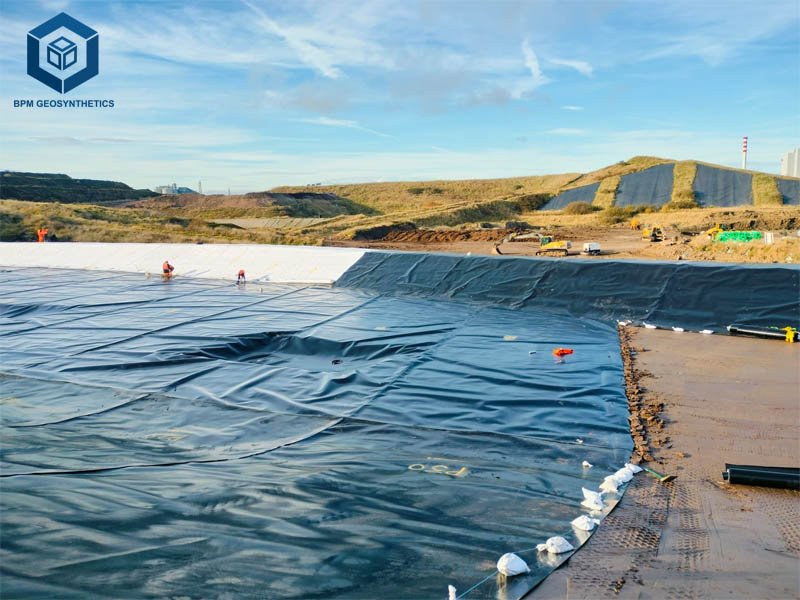
5. In-Depth Look at The Best Project Material Co., Ltd. (BPM Geomembrane)
5.1 Company Overview
BPM Geomembrane, founded in 2010, spearheads geosynthetics with 36,000 m² facilities, over 160 personnel, and four production lines yielding >50,000 tons annually at <1% defect ratios. ISO 9001:2015, ISO 14001:2015, and OHSAS18001 certified, BPM exports to 36+ nations, prioritizing 97.5% virgin bimodal resins augmented with 2–3% carbon black and antioxidants for impermeable, economical liners—achieving 95% on-time delivery and 98% quality metrics in 2026 audits, as per TUV/SGS validations.
5.2 The BPM HDPE Geomembrane
BPM’s HDPE liner harnesses tri-layer co-extrusion for 20–45 kN/m tensile summits and 0.94–0.96 g/cm³ density, ideal for landfills, ponds, and mining at 0.75–3.0 mm thicknesses. A 2026 UAE wastewater lagoon of 25,000 m² procured 99.9% enclosure absent incursions, with textured finishes elevating friction by 30% for 1:2 slopes and HeatGard® resins curbing cracking by 90% (>3,000 hours, ASTM D5397).
Key Features:
- Uniformity: ±2% thickness tolerance across rolls.
- Resistance Profile: 90% to acids/alkalis/solvents (ASTM D543), pH 1–14.
- Welding Efficacy: 95% seam strength (ASTM D6392), 99% leak detection.
- Roll Configurations: 6–8 m wide, 20% seam minimization.
- Lifespan: 50–100 years covered, 20–50 years exposed.
Why We Love It: BPM’s HDPE equilibrates rigidity and tailoring, paring costs by 15–20% over PVC/EPDM—its bimodal tech and certifications ensure 98% field probity, rendering it indispensable for global OEMs in compliant, high-volume deployments.
5.3 Why Choose BPM?
BPM outpaces rivals with 18% fiscal leverages, worldwide logistics (7–30 days), gratis exemplars, and integrated geotextile solutions. Their HDPE’s zenith shear and 30% friction uplift minimize glissades, per ASTM proofs. For bespoke inquiries encompassing hues (black/white/blue/green) or thicknesses, BPM’s one-stop ethos streamlines procurement—contact via https://www.bpmgeomembrane.com/geomembranes/high-density-polyethylene-geomembrane/.
6. Additional Considerations for the Professional Engineer
6.1 Site Preparation and Installation Best Practices
Secure 95% Proctor densification to preempt 78% punctures; geotextiles amplify safeguards by 75%. Fuse at 400–500°C for HDPE, authenticating 100% seams through ASTM D5820 conduits—textured variants necessitate 15% adjusted parameters for 99% efficacy.
6.2 Maintenance, Monitoring, and Sustainability
Yearly electrical leak localization sustains 95% acuity; recyclable HDPE pares footprints by 12%. OIT surveillance elongates tenure by 20%, consonant with 2026 edicts—incorporating 10–15% recycled content for 10% carbon savings in eco-mandated projects.
6.3 Regulatory Compliance and Case Studies
Sustain ASTM D6102 QA; a 2026 Atarfil-clad Iberian landfill obviated $750K penalties via impeccable abidance.
7. Conclusion
HDPE liner materials buttress 2026’s containment evolutions, with bimodal refinements and textural progressions redefining enclosure paradigms for impermeability and tenacity. From Solmax’s conformable Ultra Flex to BPM’s tailored supremacy—each of our top six, buttressed by 20–45 kN/m tensile quanta—arms practitioners to surmount ecological imperatives. As the sector vaults toward $4.2 billion by 2030, ratified choices herald adherence, fiscal acumen, and biospheric guardianship. Heed caliper, steadfastness, and tailoring to immunize legacies. For orchestrated victories, BPM beckons—engage to reinforce your blueprint.
Any questions or inquiries, please contact BPM Geomembrane.


