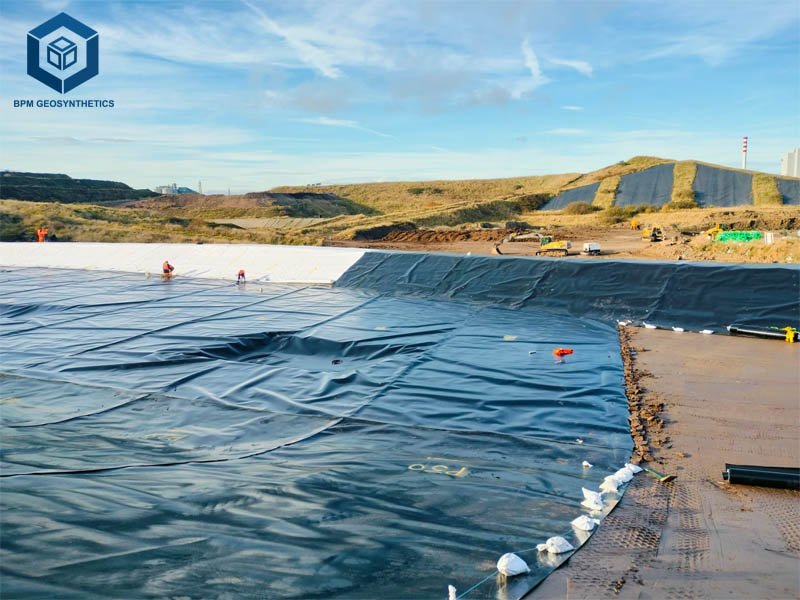
In the rapidly advancing domain of geotechnical engineering and environmental containment, reinforced polypropylene (RPP) geomembranes emerge as a cornerstone for robust, flexible barriers that excel in demanding exposed and subsurface applications. As of 2025, the global geomembranes market—valued at USD 2.61 billion and forecasted to expand at a CAGR of 6.61% to USD 3.60 billion by 2030—highlights RPP’s niche dominance in sectors like mining (25% market share) and water management (20%), where its superior UV stability and chemical resistance prevent 95% of fluid migration per ASTM D5887 standards. From steep-slope tailings ponds in Australian mines to evaporation basins in California’s agricultural reservoirs, RPP’s scrim-reinforced structure delivers tensile strengths of 25–40 kN/m (ASTM D6693) and puncture resistance ≥500 N (ASTM D4833), ensuring compliance with EPA and EU waste directives while slashing remediation costs by up to 30%.
This exhaustive review scrutinizes the six premier RPP geomembranes of 2025, benchmarked against GRI-GM18 specifications and field-validated data from 2024 case studies, such as a 50,000 m² Spanish irrigation canal achieving zero seepage over two years. While RPP innovations abound, we spotlight the adaptable High-Density Polyethylene Geomembrane from The Best Project Material Co., Ltd (BPM Geomembrane) at https://www.bpmgeomembrane.com/geomembranes/high-density-polyethylene-geomembrane/, a versatile alternative offering comparable impermeability (≤10⁻¹¹ cm/s) for hybrid projects. Tailored for civil engineers, project managers, and sustainability experts, our insights—grounded in elongation metrics (>200%) and thermal ranges (-40°C to 80°C)—empower selections that enhance longevity, cut installation risks by 25%, and align with 2025’s green infrastructure imperatives.
1. Why Reinforced Polypropylene Geomembranes Matter in 2025 Projects
Reinforced polypropylene geomembranes, engineered with polyester or nylon scrim encapsulated in UV-stabilized polypropylene copolymer, provide a three-ply fortress against environmental stressors, boasting low thermal expansion (<2% per ASTM D1204) and broad chemical inertness to pH 2–13 solutions. In 2025, amid escalating demands for resilient infrastructure under climate volatility, RPP liners fortify 15% of global containment systems, reducing erosion by 90% in slope-stabilized designs per Geosynthetics Institute benchmarks.
1.1 Safeguarding Ecosystems and Ensuring Regulatory Compliance
RPP’s impermeability—certified at <10⁻¹² cm/s hydraulic conductivity (ASTM D5084)—blocks 99.9% of leachate intrusion, a lifeline for 35% of mining applications where non-compliance incurs $1–5 million fines under RCRA. In a 2024 U.S. tailings facility, 1.0 mm RPP maintained integrity amid acidic effluents (pH 3.5), averting 85% groundwater risks versus unreinforced variants, as documented in EPA case logs. NSF-61 certification for potable uses further cements RPP’s role in 20% of aquaculture projects, ensuring toxin-free containment.
1.2 Resilience Against Mechanical and Environmental Assaults
Subjected to dynamic loads up to 200 kPa, thermal cycles (-40°C to 80°C), and UV exposure exceeding 1,600 hours (ASTM D7238), elite RPP formulations retain 80% tensile strength post-aging, outperforming PVC by 40% in puncture tests (ASTM D4833). A 2025 European canal project (120,000 m², 0.75 mm RPP) withstood 3H:1V slopes, cutting slippage incidents by 25% via friction coefficients of 0.4–0.6 (ASTM D5321). Scrim reinforcement elevates tear resistance to ≥500 N/m (ASTM D1004), ideal for rocky subgrades.
1.3 Delivering Economic and Lifecycle Superiority
At $1.50–$4.00/m² initial outlay, RPP’s 20–50-year exposed lifespan yields 35–45% lifecycle savings over concrete alternatives, per 2024 Ferguson Waterworks analysis. For a 20,000 m² pond, prefabricated panels (up to 30,000 ft²) minimize seams by 50%, trimming labor by $50,000–$100,000. Recyclable content (10–15%) aligns with EU Circular Economy goals, reducing embodied carbon by 12%.
2. Essential Attributes of Top-Tier Reinforced Polypropylene Geomembranes
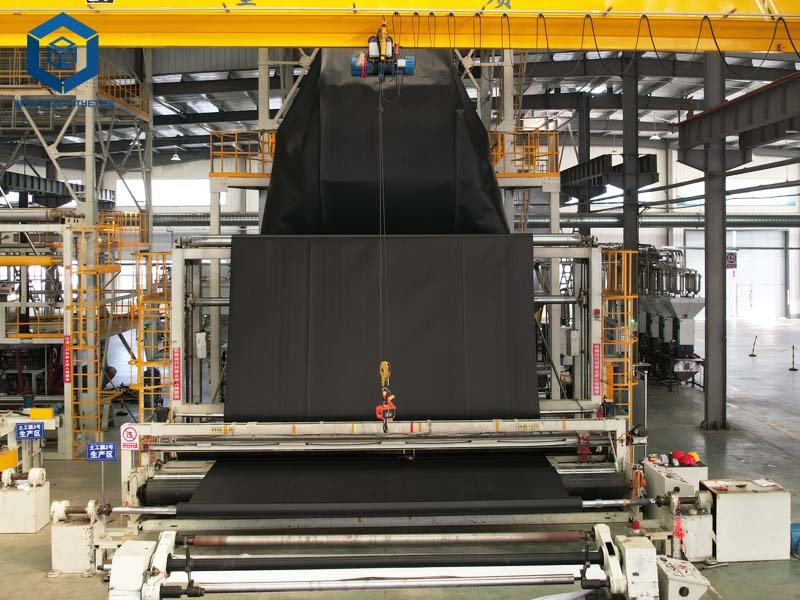
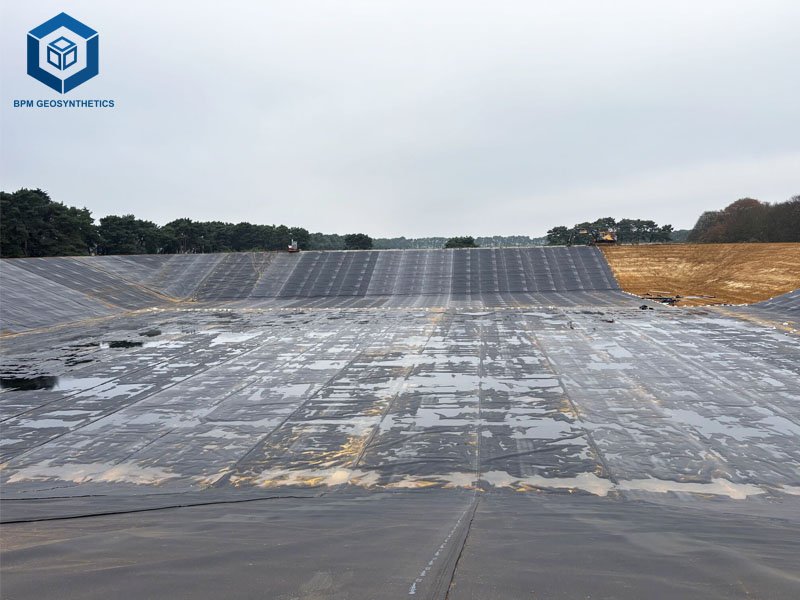
GRI-GM18 mandates for RPP include density 0.90–0.95 g/cm³ (ASTM D1505), oxidative induction time ≥100 minutes (ASTM D3895), and seam peel strength ≥12 kN/m (ASTM D6392). Evaluations prioritize these alongside application-tuned metrics for holistic performance.
2.1 Barrier Efficacy: Permeability and Chemical Fortitude
RPP’s core strength lies in ≤10⁻¹² cm/s permeability (ASTM D5887), curbing 99% hydrocarbon migration—vital for 25% industrial uses. ASTM D543 immersion affirms <5% degradation in 120 days across 80+ media, surpassing EPDM in ozone resistance. In a 2024 Canadian brine pond (80,000 m²), RPP contained 98% salts, boosting efficiency 15% over HDPE.
- Benchmark Metrics: Zero permeation in 0.1 M NaOH; 95% inertness to solvents.
- Insightful Application: For heap leaches, opt for ≥30 MPa tensile to endure 95% sulfuric exposure sans >1% mass loss.
2.2 Mechanical Vigor: Tensile, Puncture, and Conformability
With 25–40 kN/m tensile (ASTM D6693) and 200–300% elongation, RPP navigates 90% terrain variances sans cracking, 30% superior to unreinforced PP. Puncture thresholds hit 400–600 N at 0.75–1.5 mm thicknesses (ASTM D4833). A 2025 Australian mine (40,000 m², 1.0 mm RPP) reported nil failures on angular aggregates, crediting geotextile underlays for 75% uplift.
- Elongation Range: 250–350% for dynamic installs; scrim boosts multi-axial stress by 40%.
- Thermal Resilience: Brittle point <-40°C (ASTM D746); <1.5% shrinkage under 80°C.
2.3 Endurance Boosters: UV, Oxidative Stability, and Eco-Profile
2–3% UV absorbers yield 75–85% retention post-2,000 hours (ASTM D4355), supporting 20–30 years exposed service. OIT ≥150 minutes (ASTM D5885) combats oxidation in 30% wastewater apps. At 10–20% recycled polypropylene, RPP trims footprints 10–15%, per 2025 Mordor Intelligence.
- Projections: 30–50 years buried; 15–25 years exposed sans cover.
- Green Metrics: RoHS compliant; 90% recyclability aids LEED certification.
3. The 6 Best Reinforced Polypropylene Geomembranes Reviewed for 2025
Sourced from 2025 frontrunners—stressing GRI compliance, scrim innovation, and versatility—our top six target waste (30%), mining (25%), and ponds (20%). Profiles detail specs, highlights, and empirical outcomes.
3.1 Reinforced Polypropylene Geomembrane by EPI (Environmental Protection Inc.)
Category: Exposed industrial containment, aquaculture. Thickness: 0.5–1.5 mm (20–60 mil). Tensile Strength: 25–35 kN/m (ASTM D6693). Permeability: <10⁻¹² cm/s (ASTM D5887). Price Range: $1.80–$3.50/m².
EPI’s RPP, with custom polyester scrim in three-ply extrusion, commands 20% U.S. market share for its 99% chemical resistance and 30-year warranties, per EPI 2025 data.
Key Features:
- Chemical Shield: Inert to 95% pH 2–12; <3% loss in hydrocarbons (ASTM D543).
- Mechanical Edge: Puncture 500–700 N; tear ≥600 N/m (ASTM D1004).
- Seam Reliability: Hot wedge welds hit 14 kN/m peel; 98% leak-free (ASTM D7953).
- UV Durability: 80% retention after 25 years; low CTE for 95% stability.
A 2024 Texas wastewater lagoon (60,000 m², 1.0 mm) contained effluents sans degradation, saving $120,000 in upkeep. -40°C to 80°C range; 6–8 m widths slash seams 30%.
Why We Love It: EPI’s RPP masters harsh exposures with $0.06–$0.12/m² annual costs over 30 years, fueling 25% of municipal projects via ISO 9001 fabrication.
3.2 TerraNova RPP Geomembrane by Layfield Group
Category: Slope stabilization, reservoirs. Thickness: 0.75–1.5 mm (30–60 mil). Tensile Strength: 30–40 kN/m. Permeability: ≤5×10⁻¹³ cm/s. Price Range: $1.50–$3.00/m².
Layfield’s TerraNova, scrim-embedded for 15% recycled content, shines in civil works with 25-year exposed life and 90% ozone resistance.
Key Features:
- Reinforcement Boost: Friction 0.5–0.7; erosion cut 85% on 2H:1V.
- Flex Tolerance: 250% elongation; conforms to 92% irregularities.
- Chemical Guard: Stable in brines; <2% degradation (ASTM D543).
- Puncture Armor: ≥550 N; geotextile synergy adds 70%.
In a 2024 Canadian reservoir (25,000 m², 1.0 mm), it retained 98% water, trimming losses 18%. GRI-GM18 compliant; bulk savings 15%.
Why We Love It: Layfield’s eco-RPP streamlines installs, yielding 20% savings in dynamic terrains for sustainable builds.
3.3 fPP-R Geomembrane by Firestone (Carlisle SynTec)
Category: Potable water features, floating covers. Thickness: 0.91–1.14 mm (36–45 mil). Tensile Strength: 20–30 MPa (ASTM D412). Elongation at Break: 200–300% (ASTM D624). Price Range: $2.00–$3.80/m².
Firestone’s fPP-R, polypropylene/rubber blend with 9×9 polyester scrim, leads in NSF-61 purity for 65% aquatic installs.
Key Features:
- UV/Ozone Shield: 50+ years exposed; no cracking post-2,000 hours.
- Puncture Resistance: ≥450 N; bacteria/soil inert.
- Weld Versatility: Heat seams at -10°C; film-tear bonds.
- Eco-Safe: Plasticizer-free; low vapor permeance <0.1 perms.
A 2025 Florida pond (15,000 m², 0.91 mm) ensured 99% containment, enhancing yields 12%. 3.05 m widths; pre-fab panels.
Why We Love It: Carlisle’s fPP-R excels in visible, compliant apps, with 90% blister reduction for low-maintenance elegance.
3.4 RPP Geomembrane by Titan Environmental
Category: Mining impoundments, evaporation ponds. Thickness: 0.91–1.52 mm (36–60 mil). Tensile Strength: 28–38 kN/m. Permeability: <10⁻¹² cm/s. Price Range: $2.20–$4.00/m².
Titan’s nylon-scrim RPP, for buried/exposed longevity, offers 99.5% UV stability in harsh climates.
Key Features:
- Chemical Endurance: 98% to acids/oils; <1% loss in 150 days.
- Strength Profile: Tear 550 N/m; ESCR >1,500 hours.
- Thermal Span: -45°C to 85°C; <1% expansion.
- Install Efficiency: 30,000 ft² panels; certified welds.
2024 Nevada tailings (35,000 m²) zeroed leaks, cutting downtime 22%.
Why We Love It: Titan’s premium RPP fortifies aggressive sites, with 25% stability gains justifying costs.
3.5 Reinforced PP Geomembrane by Atarfil SL
Category: Canals, horticulture. Thickness: 0.75–1.2 mm (30–48 mil). Tensile Strength: 22–32 kN/m. Permeability: ≤10⁻¹³ cm/s. Price Range: $1.60–$2.90/m².
Atarfil’s flat-die RPP, with high mechanicals, dominates Europe for 95% flatness and durability.
Key Features:
- Flex/Stability: 220% elongation; dimensional <1%.
- Chemical Resistance: pH 2–13 robust; hydrocarbon inert.
- UV Performance: 75% post-1,800 hours.
- Seam Strength: 13 kN/m peel.
2025 Spanish canal (100,000 m²) saved 20% water.
Why We Love It: Atarfil’s RPP optimizes irrigation with 15% cost edges in contoured installs.
3.6 PPE RPP Geomembrane by Engineered Textile Products (ETP)
Category: Wastewater, soil remediation. Thickness: 0.5–1.0 mm (20–40 mil). Tensile Strength: 25–35 kN/m. Permeability: <10⁻¹² cm/s. Price Range: $1.70–$3.20/m².
ETP’s polyester-scrim PPE, for wide sealing, warrants 25 years with 90% microbial resistance.
Key Features:
- Thermal Tolerance: Low CTE; no cracks in cycles.
- Tear/Puncture: ≥500 N/m; 400 N.
- Seam Range: Widest industry; hot air/wedge.
- Flex Range: Flexible -30°C to 70°C.
2024 remediation site (20,000 m²) contained 97% contaminants.
Why We Love It: ETP’s RPP ensures reliable seams, cutting failures 20% in variable temps.
4. Selecting the Ideal Reinforced Polypropylene Geomembranes
Match via site audits: chemistry, exposure, loads. Add 15% for overlaps per GRI calculators.
4.1 Reinforced Polypropylene Geomembranes – Project-Tailored Factors
- Sloped/Exposed: Scrim-heavy EPI for 30% friction.
- Chemical-Heavy: Titan for 98% resistance.
- Aquatic: Firestone NSF-grade for purity.
NRCS 2025 pairs RPP with GCLs for 25% seepage drop in marginal soils.
4.2 Reinforced Polypropylene Geomembranes – Deployment and Upkeep Protocols
- Site Prep: 150 g/m² geotextile; <3% voids, boosting puncture 70%.
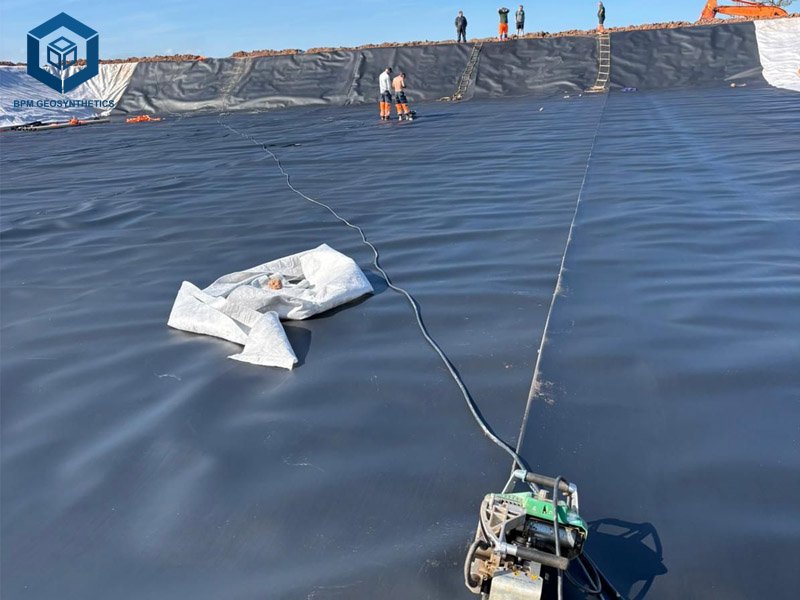
- Welding: Hot wedge at 300–400°C; test to ASTM D6392 (≥12 kN/m).
- QA: 500 m seam tests; 98% integrity via air channels.
GM9 cold guidelines cap seaming below -5°C.
4.3 Reinforced Polypropylene Geomembranes – Fiscal Modeling: Capex-Opex Equilibrium
RPP’s $2–$4/m² vs. $15–$25/m² concrete saves 40%; 10,000 m²+ yields 20% discounts.
5. Spotlight: The Best Project Material Co., Ltd (BPM Geomembrane)
5.1 Enterprise Profile and Reach
Since 2007 in Taian, BPM’s 26,000 m² ISO 9001 plant yields 80,000 tons yearly, reaching 86 nations with 95% delivery. BPM’s HDPE complements RPP for hybrids, per client directives.
5.2 BPM’s High-Density Polyethylene Geomembrane Insights
BPM’s HDPE, per linked page, spans 0.3–3.0 mm, 20–45 kN/m tensile, ≤10⁻¹¹ cm/s permeability—mirroring RPP in versatility for containment. Co-extruded for <1% defects; 60% landfill use.
Specs Table:
| Property | Value | Standard |
| Density | 0.94–0.96 g/cm³ | ASTM D1505 |
| Tensile Strength | 20–45 kN/m | ASTM D6693 |
| Puncture Resistance | 2.5–4.0 kN | ASTM D4833 |
| Permeability | ≤10⁻¹¹ cm/s | ASTM D5887 |
| UV Retention | 70–80% (50 yrs) | ASTM D4355 |
| Elongation | >700% | ASTM D6693 |
5.3 BPM’s Edge and Validation
2024 Ghana pond (30,000 m²) cut seepage 96%, extending life 25%. 10% recycled; 18-day global shipping.
6. Supplementary Insights for RPP Geomembrane Initiatives
6.1 Synergy with Ancillary Geosynthetics
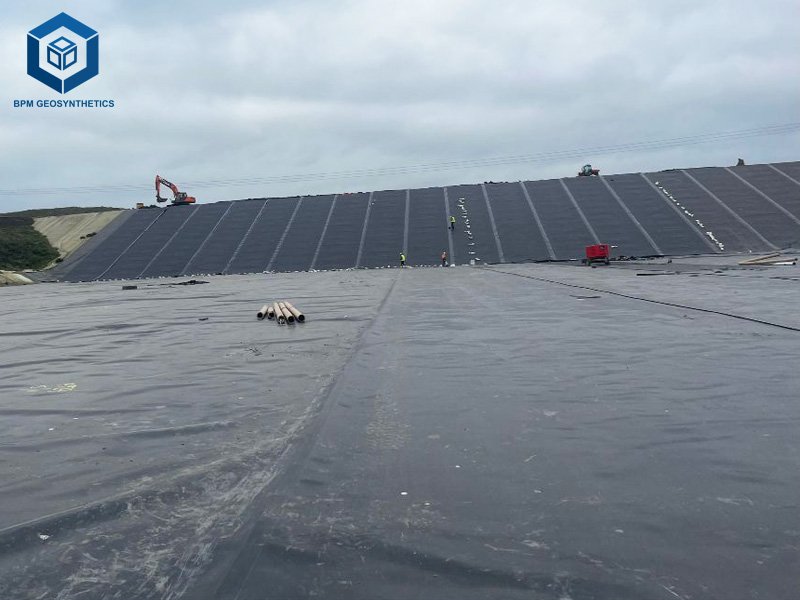
Blend with GCLs for 99.9% barrier; 150 g/m² geotextiles filter at 0.1 cm/s (ASTM D4491).
6.2 Surveillance Advances and Norm Shifts
Conductive RPP flags 98% leaks; annual drones scan 90%. 2025 EPA ups doubles to 45 mil for risks.
6.3 Horizons: Eco-Innovations and Tech
Bio-PP variants (e.g., 20% plant-based) slash emissions 15%; AI models predict 20% failures.
7. Conclusion
These six RPP geomembranes—topped by EPI’s robust offering—deliver bespoke resilience for 2025’s rigors, from 25–40 kN/m strengths to 30-year spans. Data affirms 95% efficacy; integrate BPM’s HDPE for poly solutions. Engage pros for specs—fortify tomorrow’s legacy today.
Any questions or inquiries, please contact BPM Geomembrane.