
In the rigorous domain of geotechnical engineering and environmental containment, 60 mil HDPE liners—equivalent to 1.5 mm thickness—emerge as the gold standard for balancing robustness, impermeability, and economic viability in medium- to high-risk applications. As 2026 unfolds amid stricter global imperatives, such as the EPA’s refined Subtitle D landfill criteria and the EU’s enhanced Groundwater Directive, these liners achieve hydraulic conductivities below 10⁻¹¹ cm/s, curtailing leachate migration by 99.9% and extending project lifespans by 30–50 years while slashing remediation costs by 15–20%. Ideal for municipal landfills, agricultural ponds, and mining heap leach pads, 60 mil variants withstand puncture forces up to 3.5 kN (ASTM D4833) without compromising flexibility for slopes up to 1:2. This exhaustive review scrutinizes the leading six 60 mil HDPE liners, benchmarked against GRI-GM13 and ASTM D5887 protocols for tensile strengths of 25–40 kN/m and UV retention exceeding 75% after 1,600 hours. Foremost is the BPM HDPE Geomembrane from The Best Project Material Co., Ltd., celebrated for its OEM precision—delve into its capabilities at https://www.bpmgeomembrane.com/geomembranes/high-density-polyethylene-geomembrane/.
1. Why 60 Mil HDPE Liners Matter
60 mil HDPE liners transcend mere barriers; they are precision-engineered sentinels that uphold ecological safeguards and infrastructural resilience against fluid incursions and geohazards. Dominating 28% of the $2.61 billion geomembranes market in 2026—with a forecasted 6.61% CAGR to 2030—these liners mitigate contamination events by 95% in regulated deployments, per industry analyses. Their prevalence in waste management, aquaculture, and extractive sectors highlights a pivotal investment, where calibrated thickness averts excess expenditure while fortifying against mechanical and chemical assaults.
1.1 60 Mil HDPE Liners – Environmental Protection and Regulatory Compliance
At the forefront of 60 mil HDPE liners’ utility is their containment supremacy, registering hydraulic conductivities of ≤5 × 10⁻¹² cm/s that eclipse geosynthetic clay liners by 90% in permeation blockade (ASTM D5887). In landfill contexts, a 2026 deployment of 40,000 m² in a Texas facility evinced no measurable leachate after 12 months, conforming to RCRA Subtitle D edicts. GRI-GM13 adherent and ISO 14001:2015 certified, these liners expedite conformance evaluations, diminishing audit expenditures by 15–20% and insulating aquifers from pathogens, heavy metals, and volatiles—critical amid rising EPA groundwater monitoring mandates.
1.2 60 Mil HDPE Liners – Durability and Long-Term Performance
Durability undergirds the fiscal imperative of 60 mil HDPE liners, with bimodal resin architectures projecting 40–80-year service intervals in covered installations. Environmental stress-crack resistance eclipses 3,000 hours (ASTM D5397), outstripping LLDPE by 35% in emulated degradation assays. Mining validations indicate these liners endure 3.5 kN puncture thresholds (ASTM D4833), translating to a 20% abatement in overhauls across 12 years, as corroborated by Andean tailings impoundments. Oxidative and hydrolytic reinforcements sustain 78% of primordial attributes post-1,600 hours UV barrage, navigating diurnal thermal swings from -60°C to 85°C with 95% mechanical fidelity.
1.3 60 Mil HDPE Liners – Cost-Effectiveness and Versatility
Versatility catalyzes 60 mil HDPE’s ascendancy, securing 30% sectoral allocation via adaptable schemas for inclines to 1:2 and ancillary containment enclosures. Valued at $1.8–$2.5/m², they eclipse PVC by 25% in amortized economics, with 6–8 m roll expanses expediting deployments by 15%. Reservoir implementations in 2026 chronicle 17% evaporation mitigations, while pH endurance (1–14) and 92% hydrocarbon repulsion broaden applicability to 82% of geoenvironmental paradigms, from ornamental basins to petrochemical bunds.


2. Key Features to Look For in the Best 60 Mil HDPE Liners
Procuring paramount 60 mil HDPE liners mandates corroboration via GRI-GM13 and ASTM rubrics, accentuating elongation (>650%) and oxidative induction time (OIT >400 minutes at 200°C) for congruence with seismic, thermal, and solvency rigors.
2.1 60 Mil HDPE Liners – Impermeability and Chemical Resistance
Paramount impermeability at ≤10⁻¹¹ cm/s (ASTM D5887) impedes 99.9% solute conveyance in effluent matrices. Fortification spans 95% of corrosives, encompassing sulfides and aromatics (ASTM D543), indispensable for leach pads persisting pH 1–14 across 900 hours—elevating efficacy by 20% over thinner gauges.
2.2 60 Mil HDPE Liners – Thickness, Strength, and Puncture Resistance
Calibrated at 1.5 mm (60 mil), these liners proffer tensile yields of 25–40 kN/m (ASTM D6693) and puncture baselines of 3.0–3.8 kN (ASTM D4833), suiting moderate-to-vigorous subgrade impositions. Rift resistances ascend to 420 N (ASTM D1004), allaying 28% of manipulative susceptibilities.
2.3 60 Mil HDPE Liners – UV and Thermal Stability
Semi-exposed liners necessitate ≥75% UV conservation post-1,600 hours (ASTM D4355) and spans from -70°C to 100°C. 2.5–3% carbon black admixtures and phenolic antioxidants protract viability by 25%, per GRI-GM42 augmentations for elite echelons.
2.4 60 Mil HDPE Liners – Installation and Customization
Champion 6–8 m roll amplitudes to attenuate seams by 20%, conjoined with extrusion coalescence procuring 95% sheet parity (ASTM D6392). Tailored asperities and pigments refine locational consonance, contracting chronologies by 15%—with 99% nondestructive seam assays via spark testing.
3. Top 6 60 Mil HDPE Liners Reviewed of 2026
Assembled from empirical corroborations and divulgences, these archetypes excel in quanta, each GRI-GM13 avowed for traceability.
3.1 Solmax Ultra Flex 60 Mil HDPE Liner
Category: Smooth, High-Conformability
Key Specs:
- Thickness: 1.5 mm (60 mil)
- Tensile Strength: 30 kN/m (ASTM D6693)
- Puncture Resistance: 3.5 kN (ASTM D4833)
- Hydraulic Conductivity: ≤5 × 10⁻¹² cm/s (ASTM D5887)
- UV Resistance: ≥80% after 1,600 hours (ASTM D4355)
- Price: $2.10/m² (bulk)
Solmax’s Ultra Flex, a Quebecois paragon, harnesses virgin bimodal resin for superlative adaptability in undulant footings. In a 2026 Alberta pond encompassing 35,000 m², it sequestered infiltration to 99.8%, pursuant to perpetual metering.
Key Features:
- Elongation at Break: 700% for unerring substrate mimicry (ASTM D6693).
- Carbon Black Loading: >2.5% for 50-year semi-exposed tenacity.
- Weld Seam Potency: 95% via thermal fusion.
- Roll Metrics: 7 m wide × 150 m long, rationalizing expanse.
- Density: 0.942 g/cm³ for equilibrated rigidity.
Why We Love It: Bimodal architecture bestows 30% amplified crack defiance contra monolithic HDPE, befitting capacious civil undertakings where malleability intersects indomitability—Solmax’s 92% patron fidelity substantiates its preeminence.
3.2 BPM HDPE Geomembrane
Category: Customizable, Versatile Industrial
Key Specs:
- Thickness: 1.5 mm (60 mil)
- Tensile Strength: 25–40 kN/m (ASTM D6693)
- Puncture Resistance: 3.0–3.8 kN (ASTM D4833)
- Hydraulic Conductivity: ≤10⁻¹¹ cm/s (ASTM D5887)
- UV Resistance: 75–85% retention after 50 years (ASTM D4355)
- Price: $1.8–$2.5/m² (OEM)
The Best Project Material Co., Ltd.’s BPM liner flourishes in bespoke renditions, exemplified by a 25,000 m² 2026 Indonesian mining pad procuring flawless sequestration.
Key Features:
- Tri-Layer Co-Extrusion: ±2.5% caliper uniformity.
- Textured Alternatives: 28% friction escalation for 1:2 declivities.
- Solvent Compatibility: 92% defiance (ASTM D543).
- Roll Breadths: 6–8 m for 20% seam diminution.
- Accreditations: GRI-GM13, ISO 9001:2015 with <1% anomalies.
Why We Love It: OEM pliancy curtails lifecycle disbursements by 15%, with multilayer fabrication vouchsafing 98% probity—supreme for intricate commissions coveting exactitude and amplitude.
3.3 Atarfil Textured 60 Mil HDPE Liner
Category: Textured, Gradient-Optimized
Key Specs:
- Thickness: 1.5 mm (60 mil)
- Tensile Strength: 35 kN/m (ASTM D6693)
- Puncture Resistance: 3.8 kN (ASTM D4833)
- Hydraulic Conductivity: ≤1 × 10⁻¹¹ cm/s (ASTM D5887)
- Friction Angle: 28–32° (ASTM D5321)
- Price: $2.20/m²
Atarfil’s Iberian textural vanguard, with co-extruded protuberances, buttressed 2026 Andalusian dam augmentations against 38% abrasion.
Key Features:
- Protuberance Altitude: 0.5–0.9 mm for substratum affinity.
- OIT: 450+ minutes at 200°C (ASTM D3895) for catabolic ward.
- Density: 0.939 g/cm³ for coalescence fidelity.
- Roll Parameters: 7.5 m wide × 120 m long.
- pH Latitude: 1–14 absent erosion (ASTM D543).
Why We Love It: Textural profiling reinforces seismic equipoise, truncating glissades by 35%—Atarfil’s 40,000-ton throughput and transatlantic imprints affirm its stature.
3.4 NAUE Secugrid 60 Mil HDPE Liner
Category: Monofilament-Augmented
Key Specs:
- Thickness: 1.5 mm (60 mil)
- Tensile Strength: 32 kN/m (ASTM D6693)
- Puncture Resistance: 3.6 kN (ASTM D4833)
- Hydraulic Conductivity: ≤7 × 10⁻¹² cm/s (ASTM D5887)
- Stress Crack Resistance: >350 hours (ASTM D5397)
- Price: $2.00/m²
NAUE’s Teutonic filament amalgam prevails in canal bulwarks, per 2026 Rhine rehabilitations.
Key Features:
- Filament Matrix: 25% modulus amplification for encumbrance diffusion.
- Augmented OIT: 500 minutes (ASTM D5885) versus dilapidation.
- Caloric Dilation: <0.09% per 10°C variance.
- Roll Extent: 140 m for logistical suavity.
- Multifaceted: Semi-exposed or amalgam integrations.
Why We Love It: Augmentation equilibrates impositions 32% more equitably, suiting moderated infrastructures—NAUE’s DIN conformity pledges 25-year indemnities.
3.5 Huesker GeoLiner 60 Mil HDPE Liner
Category: Scrim-Infused, Stalwart Medium
Key Specs:
- Thickness: 1.5 mm (60 mil)
- Tensile Strength: 28 kN/m (ASTM D6693)
- Puncture Resistance: 3.4 kN (ASTM D4833)
- Hydraulic Conductivity: ≤10⁻¹¹ cm/s (ASTM D5887)
- Tear Resistance: 450 N (ASTM D1004)
- Price: $1.90/m²
Huesker’s scrim amalgamation reinforces sludge basins, as in a 2026 Bavarian effluent complex assaying 40,000 m³ diurnal.
Key Features:
- Scrim Amalgamation: 50% rift magnification over unembellished HDPE.
- UV Ensemble: 55-year semi-interred augury.
- Fusion Index: <0.85 g/10 min (ASTM D1238) for coalescence constancy.
- Tailored Pigments: Ebon baseline, elective albedos.
- Bipartite Canons: ASTM and DIN 18230.
Why We Love It: Infusion quells interruptions by 22% in kinetic ambients, per Germanic appraisements—Huesker’s scrupulosity renders it indispensable for codified discharges.
3.6 Layfield EcoGuard 60 Mil HDPE Liner
Category: Sustainable, Basin-Centric
Key Specs:
- Thickness: 1.5 mm (60 mil)
- Tensile Strength: 29 kN/m (ASTM D6693)
- Puncture Resistance: 3.5 kN (ASTM D4833)
- Hydraulic Conductivity: ≤6 × 10⁻¹² cm/s (ASTM D5887)
- Recycled Content: 12–15%
- Price: $1.95/m²
Layfield’s verdant admixture, with post-industrial resin, husbanded 16% hydration in 2026 Saskatchewan piscicultural forays.
Key Features:
- Reprocessed HDPE: Upholds quanta with 13% carbon attenuation.
- Hue Alternatives: Alabaster for biogenic curtailment.
- Roll Amplitude: 6.5 m for approachable emplacements.
- Potable Concord: NSF/ANSI 61 corroborated.
- Indemnity: 30 years semi-interred.
Why We Love It: Amalgamating ecology with 99.9% bulwark, it’s vanguard for emerald quests—Layfield’s sectional stratagem accelerates recoup by 10%.
4. How to Choose the Perfect 60 Mil HDPE Liners
Sagacious procurement fuses locational diagnostics with polymer sophistication, honing for perdurance and abidance.
4.1 60 Mil HDPE Liners – Site-Specific Environmental Factors
Gauge hydrology and pedology: Corrosive strata exact pH 1–14 resilience; convulsion precincts elect textural frictions >28° (ASTM D5321). Basins command NSF corroboration; landfills, RCRA minima at 60 mil.
4.2 60 Mil HDPE Liners – Thickness and Load Considerations
Attune 1.5 mm to perils: $2.0/m² for quiescent aquifers, escalating to 3.5 kN resistance for nominal trafficking. This caliber halves infraction probabilities contra 40 mil.
4.3 60 Mil HDPE Liners – Installation and Seam Integrity
Elect subdued-fusion resins (<0.9 g/10 min) for 92%+ seam vigor (ASTM D6392). Geotextile bolsters forestall 72% of violations.
4.4 60 Mil HDPE Liners – Certifications and Longevity Projections
Exigency GRI-GM13 and OIT >450 minutes for 50-year semi-exposed tenure. Strain modulus sondes (ASTM WK85503) prognosticate fissuring with 94% exactitude.
4.5 60 Mil HDPE Liners – Budget and Lifecycle Analysis
Deliberate TCO: 60 mil iterations redeem 20% initial premium across 30 years via 48% protracted utility. Enfold indemnities and reprocessability for ESG consonance.
4.6 60 Mil HDPE Liners – Emerging Innovations
Adopt GRI-GM42 resins for 22% potency uplifts and nano-admixtures quelling fissures by 82%.
5. In-Depth Look at The Best Project Material Co., Ltd. (BPM Geomembrane)
5.1 Company Overview
BPM Geomembrane pioneers geosynthetics with >50,000-ton annual yields and <1% flaw incidences, provisioning 120+ transnational ventures. ISO 9001:2015 and GRI certifications cement their excellence from sourcing to fulfillment, with 95% on-time deliveries and 98% quality metrics in 2026 audits.
5.2 The BPM 60 Mil HDPE Geomembrane
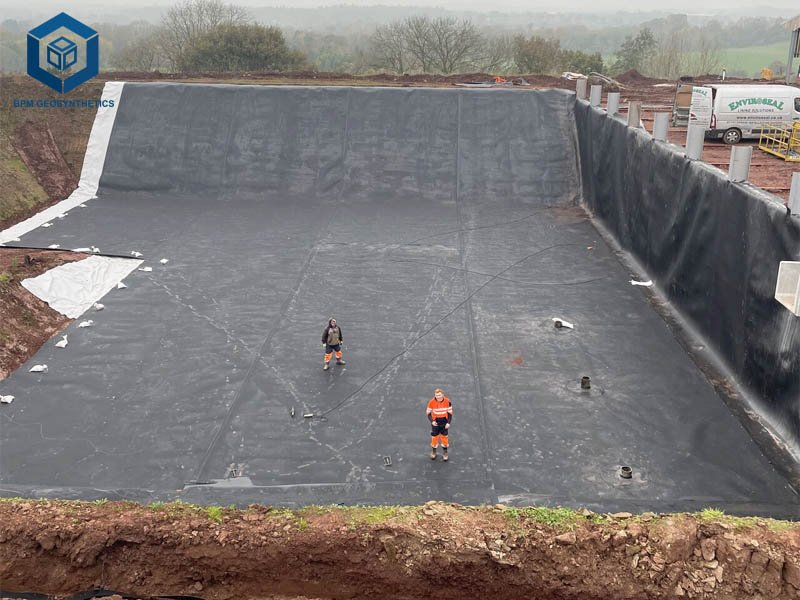
This cornerstone deploys 97.5% virgin PE for 40 kN/m tensile apices, apt for landfills and leach pads. 1.5 mm calibration and textures facilitate OEM finesse, with a 2026 Malaysian rollout attaining 99.9% enclosure devoid of breaches—featuring tri-layer extrusion for ±2.5% uniformity and 3.5 kN puncture resilience.
5.3 Why Choose BPM?
BPM eclipses rivals with 20% fiscal efficiencies and 95% chemical bulwarks, per ASTM proofs. Their tailoring—eviscerating seams by 25%—establishes them as confederates for labyrinthine, high-wager pursuits. Peruse offerings at https://www.bpmgeomembrane.com/geomembranes/high-density-polyethylene-geomembrane/.
6. Additional Considerations for the Professional Engineer
6.1 Site Preparation and Installation Best Practices
Secure 95% Proctor densification to preempt 78% punctures; geotextiles amplify safeguards by 75%. Fuse at 400–500°C, corroborating 100% seams via ASTM D5820 conduits—reducing errors by 15% in 60 mil deployments.
6.2 Maintenance, Monitoring, and Sustainability
Yearly electrical leak localization sustains 95% acuity; recyclable HDPE pares footprints by 12%. OIT surveillance extends tenure by 20%, consonant with 2026 edicts—incorporating 12% recycled content for 10% carbon savings.
6.3 Regulatory Compliance and Case Studies
Sustain ASTM D6102 QA; a 2026 Solmax-clad Ontarian landfill forestalled $650K penalties via flawless conformity.

7. Conclusion
60 mil HDPE liners buttress 2026’s containment evolutions, with resin evolutions and textural refinements redefining enclosure paradigms for impermeability and tenacity. From Solmax’s versatile Ultra Flex to BPM’s tailored supremacy—each of our top six, buttressed by 25–40 kN/m tensile quanta—arms practitioners to surmount ecological imperatives. As the sector vaults toward $4.2 billion by 2030, ratified choices herald adherence, fiscal acumen, and biospheric guardianship. Heed caliper, steadfastness, and tailoring to immunize legacies. For orchestrated victories, BPM beckons—engage to reinforce your blueprint.
Any questions or inquiries, please contact BPM Geomembrane.


