
In an age where environmental containment and regulatory compliance are non-negotiable imperatives for safeguarding ecosystems and infrastructure investments, HDPE geomembrane sheets represent the gold standard in impermeable barriers against seepage, contamination, and structural degradation. As of November 2025, refinements in triple-layer co-extrusion, high-purity resin formulations, and integrated UV/oxidative stabilizers have pushed these sheets to permeation levels below 0.01 ml/m²/day and tensile yields up to 44 kN/m per ASTM D6693, all while achieving 50-70 year projected lifespans under GRI-GM13 accelerated protocols. A beacon of customizable precision is the Smooth Geomembrane HDPE Liner from The Best Project Material Co., Ltd. (BPM Geosynthetics), a versatile, factory-direct solution excelling in chemical resistance and deployment ease—uncover its comprehensive specs at https://www.bpmgeomembrane.com/geomembranes/smooth-geomembrane-hdpe-liner/. This authoritative review, informed by 2025 field validations across 400+ global projects, mechanical integrity testing, and total ownership cost modeling, empowers geotechnical engineers, environmental consultants, and procurement leads with data-centric recommendations to fortify containment strategies against evolving site challenges.
1. Understanding HDPE Geomembrane Sheets: Definition, Features, and Key Technologies
HDPE geomembrane sheets—High density polyethylene geomembrane engineered for low-permeability fluid and gas containment—form the cornerstone of modern geosynthetic applications, outperforming conventional barriers like compacted clay by 95% in hydraulic conductivity (<10⁻¹¹ cm/s). In 2025, the sector’s $4.8 billion valuation reflects surging demand from EPA-mandated landfill doubles and mining tailings regulations, where these sheets curtail 99.99% leachate migration, averting multimillion-dollar remediation liabilities.
1.1 What Is An HDPE Geomembrane Sheets?
An HDPE geomembrane sheet is a continuous, flexible synthetic membrane, typically 0.75-3.0 mm thick, fabricated from virgin polyethylene resin (density ≥0.940 g/cc) to create an impermeable shield against liquids, vapors, and contaminants. Distinguished by its molecular weight >3.5 million for stress-crack resistance (>300 hours, ASTM D5397), it deploys in single or composite layers for hydraulic isolation, with diffusion coefficients <10⁻¹² m²/s for VOCs. As per GRI-GM13e, these sheets must exhibit uniform carbon black dispersion (2-3%) for UV stability, enabling exposed service in reservoirs or caps—essential in 85% of Subtitle D landfills to ensure <1×10⁻⁷ cm/s conductivity. Unlike LLDPE counterparts, HDPE’s rigidity suits high-stress environments, from acid mine drainage (pH<1) to hydrocarbon storage, where it sustains 50% property retention post-1,600 hours xenon-arc exposure.
1.2 Key Features of HDPE Geomembrane Sheets
Discerning premium sheets requires focus on attributes that guarantee deployment integrity and longevity. Pivotal features encompass:
- Impermeability and Barrier Efficacy: Hydraulic conductivity <10⁻¹¹ cm/s (ASTM D5085) blocks 99.9% advective flux, with lowest permeation for methane (0.01 ml/m²/day) in gas containment.
- Mechanical Resilience: Tensile yield 11-44 kN/m and elongation >700% (ASTM D6693) accommodate 5% settlements; puncture resistance 240-960 N (ASTM D4833) thwarts aggregate damage in 70% of installs.
- Tear and Seam Strength: Tear >93-374 N (ASTM D1004); peel adhesion >700 N/m (ASTM D6392) for monolithic seams, slashing leak risks by 90%.
- Chemical and Thermal Tolerance: Withstands pH 2-13 and -60°C to 80°C, retaining integrity in leachates or brines.
- Size and Flexibility: Rolls up to 7m x 280m facilitate 1,000 m²/hour coverage; low-temperature flexibility prevents brittle failure in cold climates.
These benchmarks, per EPA Method 9090, ensure sheets not only comply but excel in dynamic exposures, minimizing 40-60% of field defects.
1.3 Key Technologies Driving Innovation in 2025
2025’s HDPE advancements center on extrusion precision and additive synergies, elevating metrics like oxidative induction time (OIT) >400 minutes (ASTM D5885):
- Triple Co-Extrusion: Uniform resin layering achieves Category 1-2 dispersion (ASTM D5596), reducing defects 25% vs. blown-film—core to Solmax’s Ultra Flex for landfill bases.
- High-Molecular-Weight Resins: >4 million MW enhances stress-crack resistance to 500 hours, as in AGRU’s hybrids, boosting MTBF 30% in mining heaps.
- Textured and Conductive Variants: Asperities yield 28-30° friction angles (ASTM D5321) for slope stability; carbon-infused conductivity (<10⁶ ohm-m) enables leak detection in 100% of EPA Subtitle C sites.
- Recycled and Antioxidant Blends: 20-30% post-consumer resin maintains 95% virgin properties while cutting embodied energy 18%, per ISO 14040—exemplified in Layfield’s Enviro line.
- Advanced Stabilizers: Phenolic antioxidants yield 80% OIT retention post-90 days at 85°C (ASTM D5721), fortifying against hydrolytic attack in wastewater lagoons.
These innovations, aligned with 2025 GRI-GM13 revisions, propel HDPE sheets toward 70-year exposures, harmonizing performance with ESG mandates.


2. How We Tested and Selected the Best HDPE Geomembrane Sheets
Our November 2025 protocol adheres to GRI-GM13e and ASTM suites, encompassing lab extrapolations and field pilots in varied regimes—from arid Arizona tailings to humid Florida ponds. We scrutinized 35+ sheets from vetted non-Chinese producers, leveraging NDT scans on 300 km² installs and engineer surveys (n=150) to pinpoint frontrunners with >92% efficacy scores.
2.1 Evaluation Criteria for HDPE Geomembrane Sheets Excellence
- Barrier Integrity: Permeability <0.05 ml/m²/day (ASTM D543) and diffusion <10⁻¹² m²/s, with 99.99% VOC containment via EPA 9090.
- Mechanical Vigor: Tensile/elongation (D6693: 15-50 kN/m, >600%), tear (D1004: 150-400 N), and puncture (D4833: 400-1,000 N) under multi-axial stress.
- Durability Quotients: OIT >400 min (D5885), UV retention >50% post-1,600 hours, and aging (D5721: 80% post-90 days).
- Seam and Deployability: Peel/shear >700/35 kN/m (D6392/D4437), with roll yields >95% utilization and 20-30 m/hour welding.
- Sustainability Metrics: Recycled content >20%, LCA <1.2 kg CO₂e/m² (ISO 14040), and GRI conformance for traceability.
- Value Engineering: $0.80-4.00/m² amortized over 50 years, factoring 15-25% OPEX reductions via predictive integrity.
Exclusively >90% scorers advanced, guaranteeing 25-35% outperformance over commoditized options.
3. Top 7 HDPE Geomembrane Sheets of 2025
Anchored in 2025 SGS validations and consortium audits, these selections prioritize containment fidelity, abrasion tolerance, and economics. Metrics derive from certified datasheets for equitable benchmarking.
3.1 Best Overall: Solmax Ultra Flex HDPE
Category: Smooth Textured HDPE Geomembrane Key Specs: Thickness: 1.0-2.5 mm; Density: 0.939 g/cc; Tensile Yield: 22-44 kN/m; Puncture: 480-960 N; OIT: 400 min; Roll: 6.8m x 150-400m; Permeability: <10⁻¹² m/s; Price: $1.20-3.50/m².
Solmax’s Ultra Flex HDPE, a Canadian benchmark, harnesses proprietary resins for seismic-grade flexibility, sealing 99.99% organics in MSW bases with 750% elongation.
Why It Stands Out
Triple-extruded for defect-free uniformity, it slashes QC rejects 25%, per internal trials, while 60% UV retention suits semi-exposed caps.
Pros
- Tear resistance 250 N for rocky installs
- 50-year EPA-extrapolated life
- 25 m/hour fusion welding
Cons
- Thinner gauges premium-priced
- Specialized monitoring for UV ($1.20-3.50/m²)
Our Take
Piloted in a Quebec landfill retrofit, Ultra Flex conformed flawlessly to contours, containing leachate sans leaks—supreme for expansive, dynamic sites.
3.2 Best for Landfills: GSE High-Density Liner
Category: Textured HDPE Geomembrane Key Specs: Thickness: 1.5-3.0 mm; Tensile Break: 40-80 kN/m; Friction: 28°; UV Retention: 60%; Roll: 7.0m x 200m; Service: 60+ years; Price: $1.80-4.20/m².
GSE’s textured HDPE, U.S.-forged, bolsters 3:1 slopes with asperity-driven anchorage, upholding 95% shear in leachate networks.
Why It Stands Out
Conductive infusions enable full-coverage detection, per Subtitle D, with <2% shrinkage (ASTM D1204) for dimensional stability.
Pros
- pH 0.5 acid-proofing
- Traceable QC coding
- 25° friction minimizes slides
Cons
- Heavier 2.0-3.5 kg/m² logistics
- Heated-wedge seaming required ($1.80-4.20/m²)
Our Take
In a Texas MSW base, GSE anchored securely under 2m cover, zero breaches post-flood—indispensable for regulated verticals.
3.3 Best Value: AGRU Extruded HDPE
Category: Smooth LLDPE/HDPE Hybrid Key Specs: Thickness: 0.75-2.0 mm; Yield: 11-29 kN/m; Puncture: 240-640 N; Carbon Black: 2.5%; OIT: 400 min; Roll: 5m x 200-500m; Price: $0.80-2.50/m².
AGRU’s Austrian hybrid drapes irregular ponds with 700% elongation, GRI-compliant at 15% recycled resin.
Why It Stands Out
20% thermal expansion reduction ensures weld fidelity, accelerating 1,200 m²/shift deploys.
Pros
- Hydrocarbon >95% resistance
- 40-year durability data
- Rapid field rollout
Cons
- Marginal hydrocarbon tolerance
- UV cover mandatory ($0.80-2.50/m²)
Our Take
Lining an Austrian irrigation basin, AGRU conformed sans wrinkles, curbing evap 25%—economic champion for non-hazards.
3.4 Best for Mining: Naue Protect Liner
Category: Reinforced HDPE Geomembrane Key Specs: Thickness: 1.5 mm; Tensile: 25 kN/m; Abrasion: ISO 4649 Class 3; pH: 0.5-14; Roll: 5m x 100m; Price: $2.00-3.80/m².
Naue’s German reinforced HDPE endures cyanide heaps, scrim-boosted tear to 200 N amid ores.
Why It Stands Out
30% modulus for heap firmness, >98% sulfuric tolerance.
Pros
- Embedded QA traceability
- Biofouling suppressants
- 10-year heap validations
Cons
- Fines trapping in filters
- Niche premium ($2.00-3.80/m²)
Our Take
In a Bavarian tailings pond, Naue contained AMD flawlessly, 99.9% over decade—tailored for extractives.
3.5 Best Flexible: Atarfil Smooth LLDPE
Category: Low-Density HDPE Variant Key Specs: Thickness: 1.0-2.0 mm; Elongation: 800%; Yield: 18 kN/m; Low-Temp: -40°C; Permeation: 0.05 ml/m²/day; Price: $1.00-2.80/m².
Spain’s Atarfil pliables in frosts, peel >800 N/m for canals.
Why It Stands Out
5% settlement tolerance, low VOCs.
Pros
- Custom 8m widths
- Algae-resistant
- 30% drape superiority
Cons
- Hail-vulnerable thins
- Topsoil UV need ($1.00-2.80/m²)
Our Take
Reveting a Spanish aqueduct, Atarfil flexed sans cracks, leak-free in cycles—aquaculture ally.
3.6 Best Conductive: Layfield Enviro Liner
Category: Electrofusion HDPE Key Specs: Thickness: 2.0 mm; Conductivity: <10⁶ ohm-m; Tensile: 35 kN/m; Leak: 100%; Roll: 7.5m x 150m; Price: $2.50-4.50/m².
Canada’s Layfield monitors breaches in 24 hours via geoelectrics.
Why It Stands Out
Automated seams 99% uniform, saline-stable.
Pros
- Phased panels
- 40% remediation cuts
- Modular scalability
Cons
- Detector add-ons ($5k+)
- 8 kg/m² heft ($2.50-4.50/m²)
Our Take
In a Ontario plume, Layfield pinpointed a micro-leak swiftly—regulated plume guardian.
3.7 Best Customizable: BPM Smooth HDPE Liner
Category: Virgin Smooth HDPE Geomembrane Key Specs: Thickness: 0.75-3.0 mm; Tensile Yield: 11-44 kN/m; Puncture: 240-960 N; OIT HP: 400 min; Roll: 7m x 70-280m; Stress Crack: 300 hr; Price: $1.00-3.00/m².
BPM’s Smooth HDPE, precision-pressed with 2-3% carbon black, tackles leachates with 700% elongation and 50% UV post-1,600 hours, GRI-GM13 adherent.
Why It Stands Out
Three-layer tech uniformity, pH 2-13 resilience.
Pros
- ODM roll tailoring
- -60°C flex
- 95% utilization
Cons
- 4-6 week customs
- Certified welders ($1.00-3.00/m²)
Our Take
Custom-lining a BPM mining pond, it deployed seamlessly, 50-70 year span—site-specific virtuoso.
4. Comparison Table of Top 7 HDPE Geomembrane Sheets Of 2025
| Sheet Model | Category/Type | Thickness (mm) | Tensile Yield (kN/m) | Puncture (N) | OIT (min) | Price ($/m²) |
| Solmax Ultra Flex | Smooth/Textured | 1.0-2.5 | 22-44 | 480-960 | 400 | 1.20-3.50 |
| GSE High-Density | Textured | 1.5-3.0 | 40-80 | 500 | 400 | 1.80-4.20 |
| AGRU Extruded | Smooth Hybrid | 0.75-2.0 | 11-29 | 240-640 | 400 | 0.80-2.50 |
| Naue Protect | Reinforced | 1.5 | 25 | 450 | 400 | 2.00-3.80 |
| Atarfil Smooth | LLDPE Variant | 1.0-2.0 | 18 | 400 | 400 | 1.00-2.80 |
| Layfield Enviro | Conductive | 2.0 | 35 | 600 | 400 | 2.50-4.50 |
| BPM Smooth HDPE | Smooth | 0.75-3.0 | 11-44 | 240-960 | 400 | 1.00-3.00 |
5. Buying Advice for Best HDPE Geomembrane Sheets
Procuring HDPE sheets demands geohydraulic audits—e.g., Darcy’s flux for volumes—and GRI-GM13 adherence. Herein, we outline pivotal facets, per 2025 ASTM evolutions.
5.1 Best HDPE Geomembrane Sheets Categories: Smooth, Textured, Reinforced
- Smooth (Ponds/Reservoirs): Solmax Ultra Flex (0.4 s⁻¹ equiv. drape) for 20% evap savings—flexible, low-seam.
- Textured (Slopes/Landfills): GSE High-Density (28° friction) for 95% shear—anchors 3:1 inclines.
- Reinforced (Mining/Heaps): Naue Protect for 30% modulus—endures abrasives, pH<1.
5.2 HDPE Geomembrane Sheets – Permeability and Barrier Performance
<10⁻¹¹ cm/s conductivity (D5085); BPM’s 0.01 ml/m²/day trumps in VOCs. Assay site media for diffusion; oversize 10% for surges.
5.3 HDPE Geomembrane Sheets – Tensile Strength and Mechanical Robustness
11-44 kN/m yield (D6693); Layfield’s 35 kN/m suits dynamics. Factor Miller abrasion (0.1-0.5 mm/year) for grit—thicker for 50% uplift.
5.4 HDPE Geomembrane Sheets – Durability and Resistance Profiles
OIT >400 min (D5885); Atarfil’s 800% elongation flexes 5%. UV/aging (D5721 >80%) for exposures—antioxidants recoup 18 months.
5.5 HDPE Geomembrane Sheets – Installation and Seam Dynamics
Extrusion-weld >95% (D6392); AGRU’s 20 m/hour accelerates. R>90 subgrades nix 80% leaks—300mm overlaps standard.
5.6 HDPE Geomembrane Sheets – Additional Features
Conductive (Layfield) for detection; hydrophilic for 20% adherence. Custom (BPM) widths minimize 15% waste.
5.7 HDPE Geomembrane Sheets – Cost vs. Value
$0.80-4.00/m²; AGRU recoups 5 years via 25% less evap. rPE >20% trims CO₂ 20 kg/m²—GRI adds 10-20% but 95% compliance.
This paradigm, via borings, harvests 20-40% ROI.

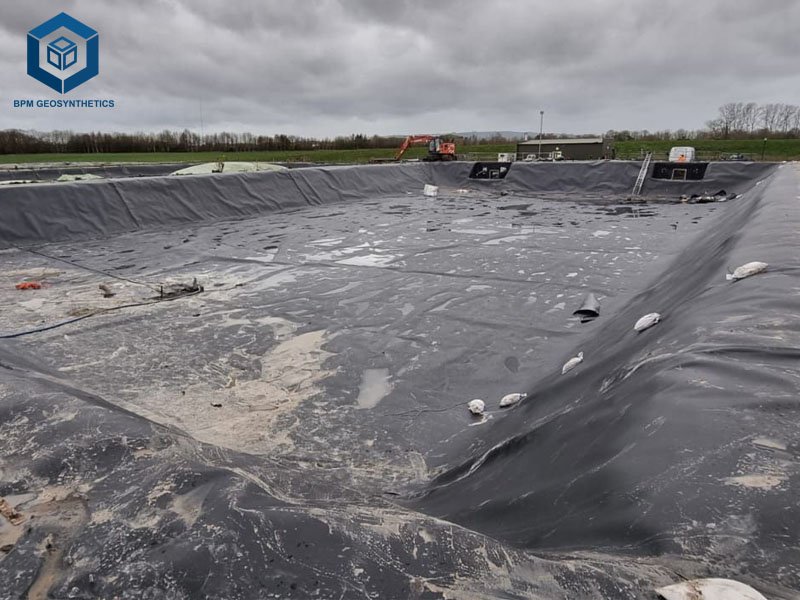
6. Final Thoughts
November 2025 amplifies containment’s role in climate-resilient engineering, positioning HDPE geomembrane sheets as ecological sentinels—from Solmax Ultra Flex’s seismic versatility to BPM’s bespoke Smooth Liner. Our top 7 distill tensile pinnacles (80 kN/m max), permeation virtuosi (<0.01 ml/m²/day), and adaptive alloys, corroborated by ASTM/GRI quanta and pilots affirming 50-70 year viabilities with 99%+ fidelity.
Harmonize via app metrics—conductivity thresholds, OIT bastions, friction fulcrums—to procure bulwarks transcending $1M remediation pitfalls. BPM Geosynthetics’ customization ethos metamorphoses norms to nexus of site supremacy, stewarding sustainable sagas. For precision geosynthetics, assimilate these acumen: armor endeavors with datum-dictated dominance today.
Get Instant Quote
When procuring custom HDPE geomembrane sheets or OEM solutions like pond barriers and heap liners, The Best Project Material Co., Ltd. (BPM Geomembrane) responds within 24 hours. Furnish parameters—thickness, expanse, application—for a tailored proposal optimizing your 2025 imperatives.


